
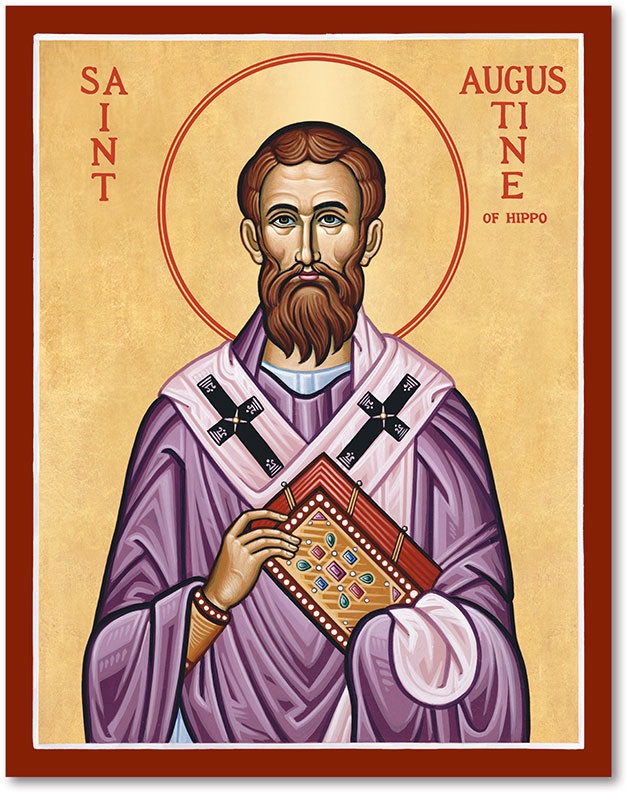
The history of Reformed theology is often presented as the recovery of truth passed down from the Apostles. However, things are not exactly so. Dr. Kenneth Wilson, an Oxford-trained theologian and orthopedic surgeon, has in the past few years made waves with his challenges to this narrative, with a provocative thesis: the deterministic theology that undergirds modern Calvinism was not a recovery of Apostolic doctrine, but a radical departure from it. Through a meticulous forensic analysis of early Christian writings, Wilson argues that the “Doctrines of Grace” (TULIP) are, in reality, a syncretism of Christian dogma with the pagan philosophies of Gnosticism, Stoicism, and Manichaeanism—imported into the church by a single man: Augustine of Hippo.
The Consensus of the Early Church
Wilson’s claims are not new, but his is the first comprehensive and systematic research on the topic. To understand the gravity these claims, one must first understand the theological landscape prior to Augustine. Wilson’s doctoral research involved reading every extant writing of the Early Church Fathers (ECF) up to the 5th century. His findings reveal a striking unanimity: for the first four hundred years of church history, Christian leaders were united in their defense of human free will.
Figures such as Irenaeus, Justin Martyr, and Tertullian did not view free will as a secondary issue. On the contrary, it was the primary demarcation line between Christianity and the pagan cults. In the early centuries, it was the Gnostics, Stoics, and Manichaeans who taught that human actions were predetermined by fate or stellar alignment. The early Christians mocked this “micromanaging” deity of the pagans, arguing that a God who must pre-script every leaf falling or rooster fighting is a “puny God” compared to the Sovereign who can grant genuine freedom to His creatures and still achieve His ultimate ends. Wilson notes that prior to 412 AD, not a single Christian author taught that God unilaterally predetermines eternal salvation or damnation.
The Manichaean Hangover
The introduction of determinism into Christian theology requires a specific carrier, and Wilson identifies him as Augustine. Before his conversion to Christianity, Augustine spent approximately a decade as a “hearer” in the Manichaean sect. Manichaeanism was a dualistic religion that viewed the material world as evil and humanity as a “mass of perdition,” utterly incapable of doing good without external compulsion.
Although Augustine eventually left the sect, Wilson argues that he never fully shed its philosophical framework. He suffered from what Wilson terms a “Manichaean hangover.” While he officially adopted Christian terminology and the Christian view of human will, Augustine retained the Stoic mechanism of meticulous providence and the Manichaean anthropology of total inability. This resulted in a theology Wilson characterizes not as “Calvinism”—a term that is anachronistic for the 5th century—but as DUPED: Divine Unilateral Predetermination of Eternal Destinies.
The Catalyst of 412 AD: The Baptismal Trap
Wilson’s chronological analysis pins down the precise moment Augustine abandoned the traditional Christian view of free will: the year 412 AD, during the heat of the Pelagian controversy. The shift was not born out of a sudden rediscovery of Paul’s epistles, but from a logical corner Augustine had painted himself into regarding infant baptism.
At the time, Augustine held to a strict view of baptismal regeneration—the belief that the water of baptism was strictly necessary for salvation. During his debates, he was confronted with the reality of infant mortality. If two infants are born, and one is baptized while the other dies due to a traffic delay or a negligent priest, the former is saved and the latter is damned. Since infants cannot exercise faith or will, Augustine was forced to ask: Why did God allow one to reach the font and not the other?
To maintain his view on baptism, Augustine concluded that God must unilaterally select specific individuals for salvation while actively withholding the opportunity from others. He imposed a deterministic cause (God’s secret election) to explain a circumstantial effect (who gets baptized). In doing so, he invented a theology where God’s will, rather than human response, became the sole deciding factor in eternal destiny.
The Invention of Inherited Guilt
To justify the damnation of these unbaptized infants, Augustine had to innovate further. The early church fathers acknowledged “ancestral sin”—that humans inherit mortality and a propensity to sin from Adam. However, they steadfastly denied that humans inherit guilt (legal culpability) for Adam’s crime.
Augustine changed this. Drawing on his former Manichaean views which demonized sexual reproduction, he theorized that the act of procreation transmits a “contagion” of legal guilt. This doctrine of “Original Guilt” posited that infants are born as a “damned mass,” deserving of hellfire not because of their own actions, but because of their biological connection to Adam. This gave Augustine the moral justification for a God who condemns those who have never consciously sinned—a concept that would eventually evolve into the Calvinist doctrine of Total Depravity.
The Great Schism of Thought
The implications of Wilson’s research suggest that the Western Church took a wrong turn in the 5th century that the Eastern Church avoided. The Greek-speaking Eastern Orthodox tradition, reading the New Testament in its original language, never accepted Augustine as a paramount theologian and never adopted the doctrine of unilateral predestination. They continued to hold the view of the earliest fathers: that salvation is a synergy of God’s grace and human response.
Wilson points out a final, biting irony: when Augustine turned to Scripture to defend his new deterministic theology, he utilized the exact same proof-texts from Romans and Ephesians that the Manichaeans had used centuries earlier to attack the Christians. In effect, the arguments once considered heretical attacks on God’s character were enshrined, via Augustine, as the “orthodox” view of God’s sovereignty in the Latin West.
Bibliography
Primary Research by Dr. Kenneth Wilson
- Wilson, Kenneth. Augustine’s Conversion from Traditional Free Choice to “Non-free Free Will”: A Comprehensive Methodology. Tübingen: Mohr Siebeck, 2018.
- Wilson, Kenneth. The Foundation of Augustinian-Calvinism. Regula Fidei Press, 2019.
Multimedia Interviews
- The Postscript. “The Foundation of Augustinian-Calvinism with Dr. Ken Wilson.” YouTube. https://www.youtube.com/watch?v=KyvXtvOHeio
- Soteriology 101. “Was Augustine the first to introduce ‘CALVINISM’ into the Church?” YouTube. https://www.youtube.com/watch?v=BnOMORGM2Qw

Leave a Reply