
Recently, my thoughts drifted back to the “Covid times” for several reasons. My plumber’s brother fell ill last year and was diagnosed with myocarditis. Interestingly, the first question the hospital doctors asked him was “How many doses of Covid vaccine did you have?” This is a stark contrast to the shunning faced by those who suggested a link between the vaccine and these conditions.
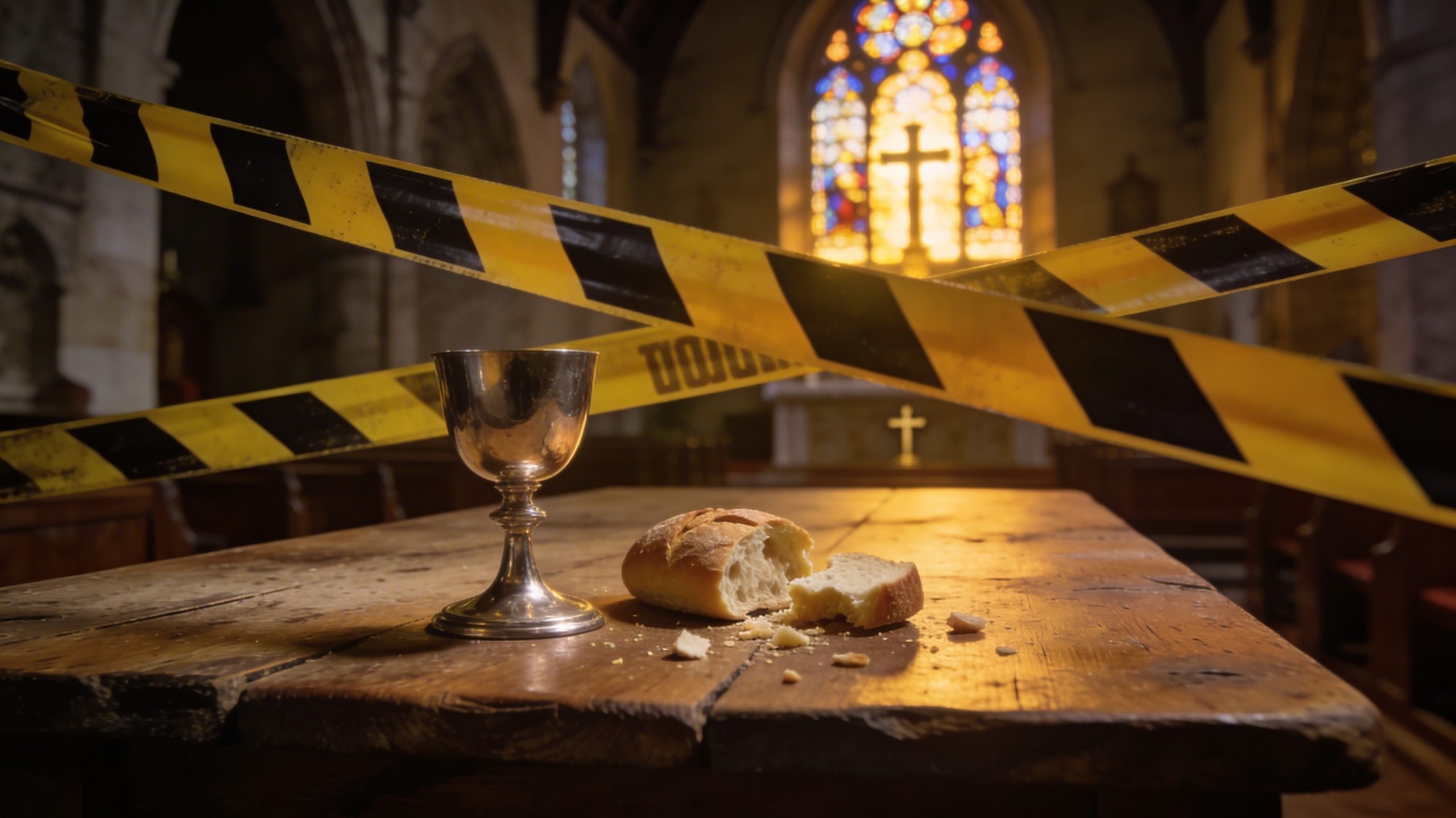
I also came across a Charlie Kirk video that subtly reminded me of the disparity during Covid. He pointed out that while the Church was deemed non-essential, strip clubs and similar “amenities” were permitted.
Furthermore, an article by our friend Amy at Projects4Missions reminded me of the situation through her analysis of practices typical of totalitarian regimes.
Between Cross and Coming: Where Was the Church?
When we gather at the Lord’s Table, we stand in a particular tension: looking back to the cross and forward to the Lord’s return. Paul reminds the Corinthians that “every time you eat this bread and drink this cup, you proclaim the Lord’s death until he comes” (1 Corinthians 11:26). In that interval—between accomplished redemption and final renewal—the Church remains on earth as the visible people of Christ, called to live in a way that makes the gospel plausible.
It is not only what we do, but how we live as we await his coming. A Church that imitates the world’s fear, adopts its propaganda, and practises its exclusions undercuts its own proclamation. The Covid years exposed precisely that: a crisis of how—a crisis of moral credibility far more serious than any epidemiological crisis.
Conformed or Transformed? Romans 12 Before Romans 13
Paul places his famous call to submission in Romans 13 immediately after a sweeping appeal not to be conformed to this world but to be transformed by the renewing of the mind (Romans 12:2). If we conform to the world, how can we expect to have any transforming effect on it?
During Covid, much of the Church responded in lockstep with secular society. The spirit of fear—explicitly alien to the Spirit given to believers—became the operative mood. Paul writes that “God did not give us a spirit of fear [cowardice], but of power, love and self-discipline” (2 Timothy 1:7), yet countless Christians lived as though death by respiratory virus were the ultimate catastrophe. A community that claims to know the One who has destroyed “him who held the power of death” and freed those held in lifelong slavery by fear of death (Hebrews 2:14–15) cannot plausibly commend that message while accepting the world’s terror campaign and even amplifying it.
To this we must add the epistemic issue. The Church is called “the pillar and foundation of the truth” (1 Timothy 3:15), yet many Christians eagerly received the same narratives as the world, long after serious counter-evidence emerged. When the people of God are indistinguishable from the world in their credulity, however piously motivated, the credibility of their gospel inevitably suffers.
Covidianism as a New Civic Religion
The Covid response functioned as a new civic religion, complete with its dogma, priesthood, liturgy, and excommunication. The “experts” became high priests of an opaque science, mediating the words of salvation (safety) to the laity. Their predictions and prescriptions were received with a deference more suited to infallible oracles than to fallible technocrats.
This religion had:
- A soteriology: salvation as avoidance of infection and death, achieved through compliance.
- A moral law: ever-changing rules presented as absolute moral duties (“stay at home”, “mask up”, “trust the science”).
- Sacraments: masks, tests, injections, QR codes—visible tokens of belonging.
- Heresy and heretics: questioning the narrative was treated as moral deviance, not mere error.
Both world and Church manifested an almost papal attitude to “experts” as priests of a new pagan order. That is precisely the theological point: when trust is relocated from God to technocratic authority, the first commandment is already compromised. Psalm 118:8 declares that it is better to take refuge in the Lord than to trust in man; yet “following the science” often meant suspending critical thought in favour of social and institutional conformity. Which really has nothing to do with science.
The Mask and the Face: A Theological Cost
Almost no church leader discussed this publicly: hiding the face is not anthropologically neutral. Scripture consistently treats the face as the primary site of personal revelation and communion. God “makes his face shine” as a sign of favour; the absence or hiding of the face signifies judgement or distance (e.g., Psalm 27:8–9; Isaiah 45:15).
Human faces participate in this theological grammar. To cover the face systematically, especially in worship and fellowship, is to disrupt the embodied language of personhood and communion. Post-Fall, hiding the face or presence is associated with dissimulation; masks, while sometimes necessary in particular medical contexts, acquire a symbolic cost when universalised. The Church, called to be the transparency of Christ’s face to the world, adopted practices that literally obscured the most basic sign of incarnate presence. That does not render every use of masks sinful, but it does mean the ecclesial cost was never theologically weighed; it was assumed that bodily practices are neutral and that “love” simply equals risk minimisation. That assumption is neither biblical nor historically Christian.
Worthy or Unworthy?
Paul rebukes the Corinthians not for failing some mystical level of personal holiness, but for discriminating within the body and turning the Lord’s Supper into a class-divided, socially stratified meal (1 Corinthians 11:27–29). “Eating and drinking unworthily” means participating in a way that contradicts the gospel signified by the Supper—specifically, by despising certain members of Christ’s body.
Exclusion or shaming of unvaccinated believers, refusal of entry to those without masks or passes even when legally exempt, churches checking “green passes” at the door, Christian camps and events effectively barring whole groups of brothers and sisters. That is not a marginal analogy. When a church requires state-sanctioned health papers as conditions of entry to worship or the Supper, it has reintroduced a de facto purity code foreign to the new covenant. It denies, in practice, Jesus’ own promise: “whoever comes to me I will never cast out” (John 6:37).
Paul’s concerns about “discerning the body” thus map uncomfortably well onto the Covid segregation that we saw during that time. When we treated certain believers as walking biohazards—unclean, unfit to be near or to eat with—we have already failed to discern the body, whatever our motives.
Regime Tactics and the Inversion of True Encouragement
Our friend Amy’s article, “Threads of Grace in Relationships,” offers a helpful contrast, even though it does not address Covid directly. It reflects on Hebrews 10:24–25: believers are commanded to “consider how” to stir one another to love and good works, through intentional, strategic, thoughtful care, and to resist the isolating effects of discouragement. The article notes how systematic isolation, such as in the Korean War, can demoralise and destroy prisoners; the Christian calling is the opposite—to weave “threads of grace” that sustain life.
During Covid, governments employed tactics that mirror the very mechanisms psychologists identify as destructive:
- Isolation of individuals from their communities.
- Constant discouraging messaging.
- Conditional access to basic life functions based on compliance.
These are classic regime tools. “Threads of Grace” explains why encouraging, embodied presence is life-giving and how relational warmth combats despair. Covid management did the opposite: it deliberately removed the warm, face-to-face, embodied threads that hold people together, replacing them with mediated, surveilled, conditional contacts. That this was done in the name of “protecting the vulnerable” did not alter the underlying pattern; it simply provided moral cover for relational sabotage.
The Church, which should have been the one place where isolation was resisted and embodied presence guarded as essential, instead became an enforcement arm. Where Hebrews 10 commands us not to neglect meeting together “as some are in the habit of doing” but to encourage one another all the more as we see the Day approaching, many congregations made neglect the rule and encouragement an online option, at best.
Romans 13 and the Limits of Submission
A deep treatment of Romans 13 is unavoidable, because much ecclesial compliance was justified by appeal to this text. Paul commands: “Let every person be subject to the governing authorities, for there is no authority except that which God has established” (Romans 13:1). Many took this as an absolute requirement of obedience, provided the State framed its decrees as concern for public health.
Several exegetical observations are needed.
- Romans 13 stands within Romans 12–13, not apart from it.
The same Paul who commands submission also commands non-conformity to the world (12:2) and warns against being wise in one’s own eyes (12:3). Submission cannot mean a thoughtless alignment with prevailing narratives or abdication of moral discernment. The Christian is never authorised to suspend critical judgement “because the government said so”. - The authority described is ideal, not absolute.
Paul describes rulers as “God’s servants to do you good”, “agents of wrath to bring punishment on the wrongdoer” (13:4). The text assumes a government that, in some basic sense, punishes evil and rewards good. When a regime systematically rewards deceit, punishes dissent, and coerces conscience, it no longer fits Paul’s description. Submission in such cases must at least be qualified. - Submission is not identical with obedience.
The verb ὑποτάσσω (“be subject”) in Scripture can denote respectful recognition of order, not uncritical compliance in every specific command. Elsewhere, the apostles refuse direct orders from authorities when those orders contradict divine commission: “We must obey God rather than men” (Acts 5:29). Any reading of Romans 13 that forbids such conscientious disobedience is plainly incompatible with Acts. - The civil and ecclesial spheres are distinct.
The has been confusion between civil and ecclesiastical government and the neglect of qualifying adjectives in texts like Romans 13 and 1 Peter 2. The State has no divine mandate to regulate the internal life of the Church, its worship, or sacramental practice, except in the most indirect sense of maintaining public order. When civil authorities prohibit Christian assembly, silence congregational singing, or condition worship on medical status, they step beyond their God-given jurisdiction.[pergrazia]
This is where the Romans 13 appeal became an instrument of cowardice rather than courage. The fear in 2 Timothy 1:7 is best glossed as “cowardice”; God has not given us a spirit of cowardice. To invoke Romans 13 in order to baptise cowardice—withdrawal from costly compassion, retreat from embodied ministry, acceptance of unjust exclusions—is a misuse of the text.
The False Righteousness of Covid Legalism
Much of the Church’s behaviour during Covid can be described as legalism in contemporary dress. Christians adopted a false morality: laws and rules that were often unjust before God, embraced to appear righteous before the world.
Examples include:
- Treating masks, distancing, and vaccination as badges of moral status, not prudential tools.
- Equating compliance with commandments of God, and non-compliance with selfishness or lack of love.
- Dividing congregations over matters not directly tied to doctrine or moral conduct, but to temporary policy.
This is pharisaic in structure: an eagerness to be “holy” according to human standards, even when those standards transgress divine justice. Judges 21:25 laments a time when everyone did what was right in his own eyes; during Covid, “what is right” was outsourced to governmental and media narratives, and then sacralised within the Church. Jesus blesses those who hunger and thirst for God’s righteousness, not the world’s latest redefinition. For those who suffered under unjust measures, the Church’s complicity has made it harder, not easier, to see God’s justice as good news.
The slogan “we do this out of love” was often deployed to justify participation in systems of exclusion and surveillance. This “love” frequently ignored those harmed or killed by the measures themselves—lonely elderly, isolated children, financially ruined families. Any ethic that reserves compassion for one group at the cost of others, while refusing to reckon with the trade-offs, bears little resemblance to biblical love.
Lockdowns and the Immorality of Withdrawing the Church
The moral costs of lockdowns, including spiritual costs, require direct confrontation. Lockdowns were presented as neutral, even virtuous, pauses in social life for the sake of health. But they were not neutral: they massively increased loneliness, economic precarity, mental health crises, and delayed medical care. For the Church, the central question was never simply “do they reduce viral spread?” but “what does it mean for the body of Christ to withdraw its presence at the point of greatest need?”
Historically, Christians have entered, not fled, times of plague and crisis. The early Church’s witness during epidemics in the Roman Empire is well documented: believers cared for the sick at risk to themselves, often welcoming the dying as an opportunity to show Christ’s love. They were not reckless, but they refused to treat self-preservation as the supreme good.
The Angel Church, which stayed open in London despite government pressure, exemplifies a different moral imagination: serving a higher law of God, refusing to discriminate through passports or tracking, continuing to sing and gather as acts of obedience and love. That model contrasts starkly with churches that, in effect, closed their doors when their neighbours most needed embodied hope.
Mild Eschatological Parallels: A Dress Rehearsal
It is neither wise nor necessary to declare Covid “the mark of the beast”. Yet the pattern is too obvious to ignore. Revelation 13 portrays a system in which economic participation becomes contingent on bearing a mark of allegiance. Covid vaccine passports, digital passes, and QR codes were not that final mark, but they proved the feasibility and public acceptability of such mechanisms. In some countries, citizens could not work, dine, travel, or sometimes even attend worship without presenting a digital token.
From a biblical perspective, that ought to have rung alarm bells not of panic, but of discernment. Covid management revealed how easily a global narrative, accompanied by moral rhetoric and fear, can justify the rapid adoption of control infrastructure. Christians who recognise that future global governance will likely employ similar tactics should treat the Covid era as a providential warning: a demonstration of how quickly “normal life” can be conditioned on compliance with ideologies that may, in time, become explicitly anti-Christian.
That does not mean every health measure is suspect; it does mean the Church must recover an instinctive suspicion of systems that tie basic participation in society to state-defined moral conformity.
Love, Presence, and the Recovery of Moral Backbone
Hebrews 10’s injunction not to neglect meeting together is not a quaint preference for in-person gatherings; it is tied to the Church’s role in sustaining one another as the Day approaches. Relational encouragement is literally a matter of life and death, contrasting the lethality of isolation with the life-giving power of intentional presence. In light of that, the Church’s ready embrace of extended physical withdrawal, mediated by screens and governed by ever-shifting rules, looks less like wise precaution and more like a failure of nerve.
Much of the Church’s acquiescence appears as an attempt to avoid the cost of dissent—to remain respectable and “responsible” in the eyes of the world. But Jesus never promised safety; he promised a cross. Salt that has lost its savour is good for nothing but to be trampled underfoot. A Church that behaves indistinguishably from secular institutions in times of crisis should not be surprised when it is treated as dispensable.
Towards a Worthy Participation
When we approach the Lord’s Table after Covid, are we doing so worthily or unworthily? The answer is not a simple indictment of every congregation or individual. There were churches that stood firm, pastors who refused to segregate the flock, believers who quietly but steadfastly resisted unjust policies. But in the main, the Church in the West demonstrated a worrying readiness to conform to the world, to sanctify fear, and to discriminate within the body of Christ.
To come to the Table in a worthy way now requires at least:
- Honest confession of complicity where we have participated in lies, exclusions, and cowardice.
- A renewed commitment to non-conformity, especially in our epistemic and moral posture.
- A clear-eyed, critical reading of Romans 13 that honours legitimate authority without idolising state power.
- A rediscovery of the theological weight of embodiment, the face, and gathered presence.
- A deliberate resolve to resist future attempts—whatever the pretext—to condition worship and fellowship on compliance with unjust systems.
The Lord’s Supper proclaims both the death that saves us and the return that will judge us. Between those two poles, the Church’s calling is not to manage its reputation, but to bear faithful witness. The Covid years show how quickly that calling can be obscured by a counterfeit righteousness. The next crisis—medical, environmental, digital—will test whether we have learned anything.

Leave a Reply