
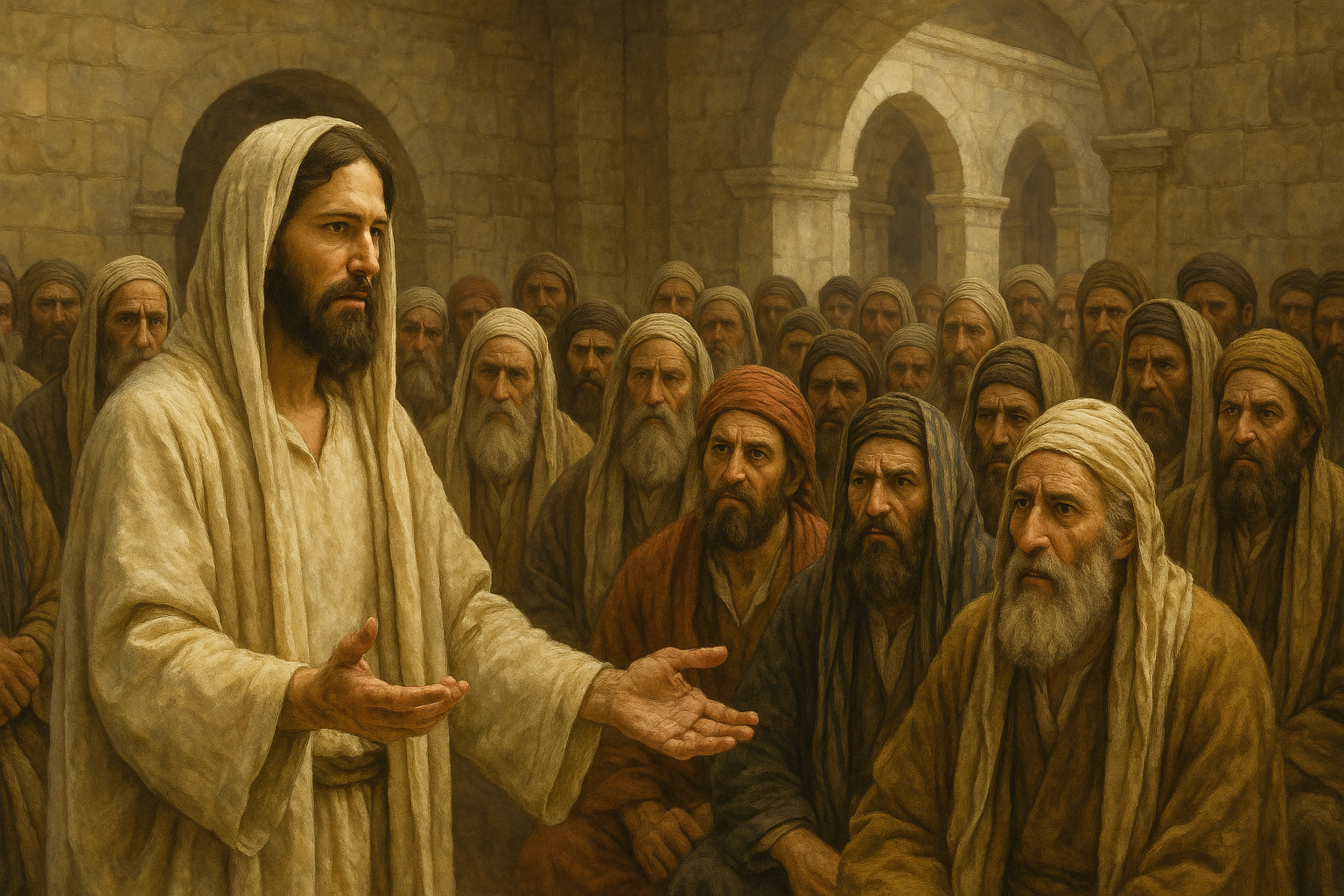
The eighth chapter of John’s Gospel contains one of the most misunderstood dialogues in the New Testament. It begins with the beautiful statement, “As He spoke these things, many believed in Him” (John 8:30), but within only a few verses, those who appear to have believed are called liars, murderers, and children of the devil. For centuries, commentators have struggled to explain this tension. Did these “believers” lose their faith? Was their belief insincere from the start? Is belief not sufficient? Or is something else happening in the narrative that many have failed to see?
The answer lies not in diminishing the meaning of belief, but in reading carefully what John actually wrote.
Belief and Abiding
In verse 31, John records that “Jesus was saying to those Jews who had believed Him…” The Greek construction uses the perfect participle of pisteuō (to believe), indicating a completed act with continuing results. These individuals had believed and therefore remained in that state. There is no linguistic or theological ground for assuming that their faith was spurious or temporary. In John’s Gospel, believing in Jesus (pisteuō eis auton) always denotes genuine trust in His person as the Christ, the Son of God.
To these new believers Jesus offers a further invitation: “If you abide in My word, you are truly My disciples, and you will know the truth, and the truth will make you free.” The condition of abiding—remaining, continuing, persevering—is addressed to those already saved. It is not a test of the genuineness of their faith, but an exhortation to grow in it. A believer may or may not abide; abiding leads to discipleship and experiential freedom, not to salvation itself.
Thus, the distinction is crucial: belief makes one a child of God; abiding makes one a mature disciple.
The Sudden Interruption
Immediately after Jesus’ promise of freedom, we read: “They answered Him, ‘We are Abraham’s descendants and have never been enslaved to anyone.’” (v. 33). The question that has perplexed so many interpreters is—who are they?
The assumption that they refers to the believers of verses 30–32 creates an irreconcilable contradiction: how can those who had just believed now resist Jesus and seek to kill Him? Yet, the Gospel of John provides its own solution through the pattern of conversation it employs. In chapters 7 and 8, Jesus often speaks to one group and is interrupted by another. Pronouns shift abruptly, and John frequently identifies speakers only after the fact. The effect is a deliberate literary ambiguity that mirrors the confusion of the crowd.
In this context, the “they” of verse 33 refers not to the believers just addressed, but to a different group within the same audience—the unbelieving Jews who were listening and could not bear His words. John does not explicitly mark the change, but the progression of thought and tone makes it unmistakable.
From verse 33 onward, Jesus’ words are directed to His opponents. These are the ones who claim Abraham as their father, who seek to kill Him (v. 37), and whom He identifies as children of the devil (v. 44). They reject His word because it “has no place” in them. By contrast, those who had believed in Him remain silent; the discussion has shifted to another set of interlocutors entirely.
Jesus’ Two Audiences
When we recognise this shift, the passage regains its coherence. Jesus first speaks to those who believed, offering them a path of growth and fellowship through abiding in His word. Then He confronts the unbelieving leaders who interrupt, exposing their hypocrisy and spiritual bondage.
To confuse these two audiences is to distort the message entirely. It leads to the mistaken idea that faith in Christ can be false, that salvation depends not on believing but on the endurance or fruit that follows. Yet John consistently presents faith as a single act of trust that secures eternal life. The fruit of discipleship, while desirable, belongs to the realm of fellowship and maturity.
Jesus’ words in this passage therefore trace a natural progression:
- Faith (v. 30) — Many believed in Him.
- Abiding (vv. 31–32) — A call to grow through His word.
- Rejection (vv. 33–59) — A confrontation with unbelief.
Only by keeping these distinct can we preserve the integrity of John’s testimony and the grace it proclaims.
Freedom in the Son
When Jesus declares, “You will know the truth, and the truth will make you free,” He speaks not of political liberty but of spiritual reality. Truth liberates from ignorance, fear, and the enslaving power of sin. Yet that freedom belongs to those who first believe and then abide. It is offered, not as a condition for acceptance, but as a gift to those already received by faith.
The unbelieving crowd misunderstands because they are blind to their bondage. They insist they have never been enslaved, forgetting Egypt, Babylon, and even Rome. Jesus pierces their illusion: “Everyone who commits sin is the slave of sin… but if the Son makes you free, you will be free indeed.”
To the believers, this freedom was already theirs to explore. To the objectors, it was still an open invitation.
Conclusion
The scene in John 8 is not a tragic story of believers turning against Christ, but a vivid portrait of how faith and unbelief can coexist in the same crowd. Jesus’ words move fluidly between those who have trusted Him and those who resist Him. The confusion arises only when we fail to discern the change in audience.
John’s Gospel was written that we might believe that Jesus is the Christ, the Son of God, and that believing we might have life in His name (20:31). That life begins with faith, grows through abiding, and shines as truth sets us free. But faith remains the beginning—and the unshakable foundation—of it all.


Leave a Reply