
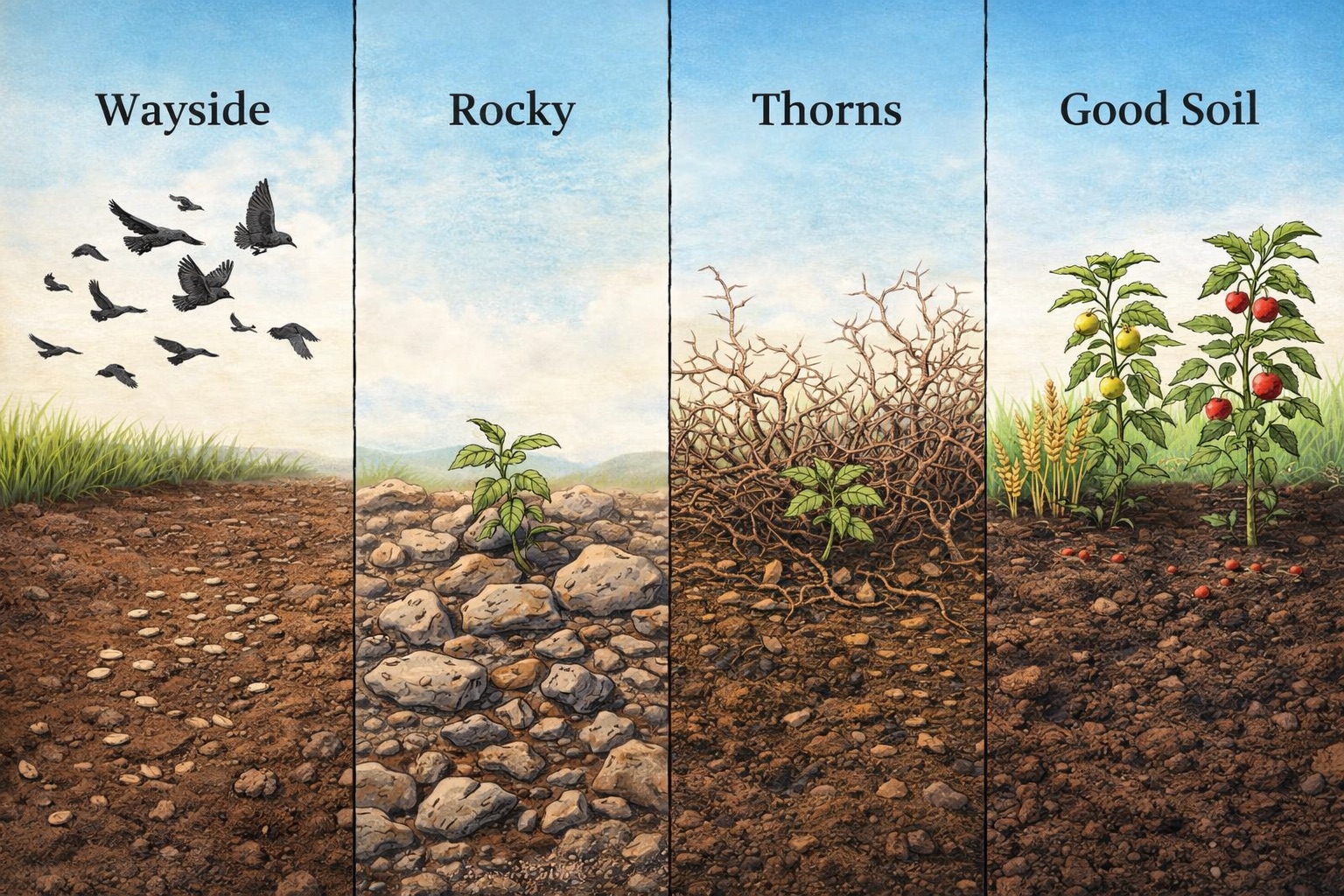
The parable of the sower is one of the most frequently cited passages in debates about salvation, perseverance, and assurance. It is often pressed into service to answer a question it was not designed to address, namely how to distinguish true believers from false ones, or how salvation may be lost or proven by works.
A careful reading of the text shows that Jesus is not explaining how one becomes saved, nor how to test the reality of salvation. Rather, He is explaining why the proclamation of the word of the kingdom produces such radically different outcomes among those who hear it.
The parable concerns reception of the word, response over time, and participation in kingdom fruitfulness, not the acquisition or loss of eternal life.
The interpretive key given by Jesus
Any responsible exegesis must begin where Jesus Himself begins. In Matthew 13:18–23, Mark 4:13–20, and Luke 8:11–15, Jesus explicitly interprets the parable.
Before offering that interpretation, however, Jesus makes a striking and often overlooked statement:
“Do you not understand this parable? How then will you understand all the parables?” (Mark 4:13).
This remark elevates the parable of the sower to a foundational role. Jesus presents it as a hermeneutical gateway, implying that misunderstanding this parable will inevitably lead to misunderstanding the others.
The reason is not difficult to discern. The parable of the sower establishes a fundamental distinction between hearing the word, receiving life, and bearing fruit. If these categories are collapsed into one, then all subsequent parables dealing with stewardship, faithfulness, reward, and loss will be misread as statements about the acquisition, retention or loss of eternal life.
The constant elements are clear:
- The seed is the word.
- The soils represent different kinds of hearers.
- The decisive variable is not the seed but the condition of the soil.
At no point does Jesus redefine the seed as saving faith, nor does He equate fruit-bearing with justification. The parable describes what happens after hearing, not how one is eternally saved.ed.
Soil one: the wayside hearer
The first soil represents those who hear the word but do not understand it. The word is immediately taken away.
This hearer never truly receives the message. There is no internalisation, no belief, and no response. Jesus is explicit that Satan removes the word before it takes root.
This soil represents the unsaved. There is no entry into the kingdom because there is no faith. All theological systems broadly agree at this point.
Soil two: the rocky places
The second soil hears the word and receives it with joy. This language is important. There is a genuine, positive response to the message. The problem is not initial reception but lack of endurance.
When affliction or persecution arises because of the word, this hearer stumbles.
Several observations are crucial. Jesus never says the plant was false. The problem is not disbelief but lack of root. The falling away is explicitly connected to pressure and suffering, not moral rebellion or doctrinal denial.
This hearer is saved eternally, because the word was received. However, the absence of perseverance under trial results in no participation in kingdom benefits. The believer remains alive, but unfruitful.
This fits naturally with the New Testament’s repeated warnings to believers about loss, discipline, and missed reward without implying loss of eternal life.
Soil three: amongst the thorns
The third soil also receives the word, and growth clearly occurs. The issue is not persecution but competition.
The cares of this world, the deceitfulness of riches, and the desire for other things choke the word, rendering it unfruitful.
Once again, the text does not say the plant dies. It says it becomes unfruitful.
This hearer represents a believer who invests his life in the present age rather than the kingdom. Eternal salvation is not revoked, but kingdom fruit and reward are forfeited.
The distinction between life and fruitfulness is essential. Scripture repeatedly affirms that fruit is the goal of discipleship, not the condition of salvation.
Soil four: the good ground
The final soil hears the word, understands it, and bears fruit in varying degrees.
Even here, Jesus emphasises diversity. Some bear thirtyfold, some sixtyfold, some a hundredfold. Fruitfulness is real, but it is not uniform.
This soil represents believers who not only receive the word but also persevere, prioritise the kingdom, and allow the word to shape their lives. They experience a fuller share in kingdom benefits, both now and in the age to come.
Why fruit cannot define salvation
A key error in many interpretations is collapsing salvation and discipleship into a single category.
If fruit proves salvation, then degrees of fruitfulness imply degrees of justification. Temporary barrenness would imply temporary damnation. Warnings to believers would become threats against eternal life rather than exhortations toward faithfulness.
The parable itself resists this move. Three of the four soils receive the word. Only one bears fruit. Yet Jesus does not redefine reception of the word as illusory simply because fruit does not follow.
The issue is not who is alive, but who is productive.
The kingdom focus of the parable
Jesus introduces this parable as one that explains the mysteries of the kingdom of heaven. The kingdom theme governs the entire chapter.
Entrance into the kingdom is by faith. Participation in the kingdom’s rewards, responsibilities, and joy is conditioned upon faithfulness.
The parable of the sower explains why the proclamation of the kingdom produces many believers but relatively few fruitful disciples.
Furthermore, Jesus’ warning in Mark 4:13 explains why later parables concerning servants, stewardship, reward, and loss are so often misread as conditions for eternal life rather than as exhortations addressed to those who already possess life but may forfeit fruitfulness, responsibility, and rewards in the kingdom.
Conclusion
The parable of the sower is not a warning that salvation may be lost, nor a tool for questioning the reality of faith in struggling believers. It is a sober explanation of why the word of God, though powerful and life-giving, so often fails to produce lasting fruit.
This reading honours the text by preserving the distinction Jesus Himself maintains between receiving life and bearing fruit. Eternal salvation rests on faith alone. Kingdom fruitfulness depends on perseverance, priorities, and response to the word over time.
The tragedy portrayed in the parable is not lost salvation, but lost opportunity.
Leave a Reply