
In modern evangelical circles, we often hear a message that sounds deeply pious: “If you want to be saved, you must surrender every area of your life to God. You must put everything on the altar. You must pay the price of discipleship to receive the gift of salvation.”
While these sentiments may aim to produce dedicated followers of Christ, they often inadvertently obscure the very heart of the Gospel. As the great preacher H.A. Ironside pointed out, when we make our “full surrender” a condition for salvation, we aren’t preaching the Gospel—we are preaching a “burdensome variant” that rests on human effort rather than divine accomplishment.
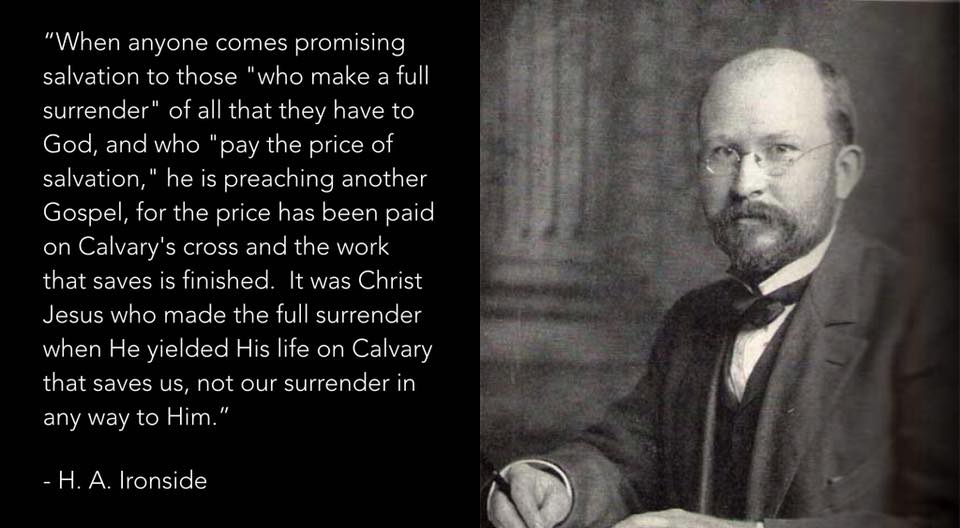
“When anyone comes promising salvation to those “who make a full surrender” of all that they have to God, and who “pay the price of salvation,” he is preaching another Gospel, for the price has been paid on Calvary’s cross and the work that saves is finished. It was Christ Jesus who made the full surrender when He yielded His life on Calvary that saves us, not our surrender in any way to Him.”
Who paid the price?
If salvation requires us to “pay the price” through our surrender, our devotion, or our promises of future obedience, then salvation is no longer a gift; it is a wage. It becomes a transaction where we offer our “surrender” in exchange for God’s mercy.
Ironside famously argued in his writings, such as in God’s Unspeakable Gift, that the Gospel is not a list of requirements for man to fulfill, but a proclamation of what God has already done. He wrote:
“The Gospel is not a call to repentance to the unsaved in the sense of ‘turning from sin’ in order to be saved… It is the good news that Christ died for our sins, was buried, and rose again.”
When we add “full surrender” to the entry requirements, we shift the sinner’s gaze away from the Cross and back onto their own fickle heart. The question changes from “Is Christ enough?” to “Is my surrender sincere enough? Is it ‘full’ enough?” This leads to a life of legalistic anxiety rather than the “peace that passes understanding.”
Ironside flips the script beautifully: “It was Christ Jesus who made the full surrender when He yielded His life on Calvary.”
The “price” of salvation was indeed high—so high that no amount of human surrender could ever meet the demand. Only the perfect, sinless Son of God could pay it. On the cross, Jesus cried out, “It is finished” (John 19:30). He did not say, “It is finished, provided you surrender everything to Me.”
The surrender that saves us is not our surrender to Him, but His surrender to the Father’s will on our behalf. He took the burden so that we might take the gift.
The true free grace offered by the Gospel is an invitation to rest. The “burdensome variants” preached today offer a treadmill of spiritual performance. They tell the lost soul that they must clean up, bow down, and promise away their lives before they can be accepted.
But Ironside reminds us that devotion should follow. For our own good. Devotion is the grateful response of a heart that has realised its debt was paid in full by Another. That devotion can materialise in a single way: love. Love God and your neighbour (Mt 22:37-40). Love one another like Christ loved us (Jn 13:34-35). Love like Christ (1 Co 13).
If you are weary from trying to “surrender enough” to earn God’s favor, look back to Calvary. The work is finished. The price is paid. The grace is truly, wonderfully free.
“The Gospel is not good advice to be obeyed; it is good news to be believed.” — H. A. Ironside
Leave a Reply