
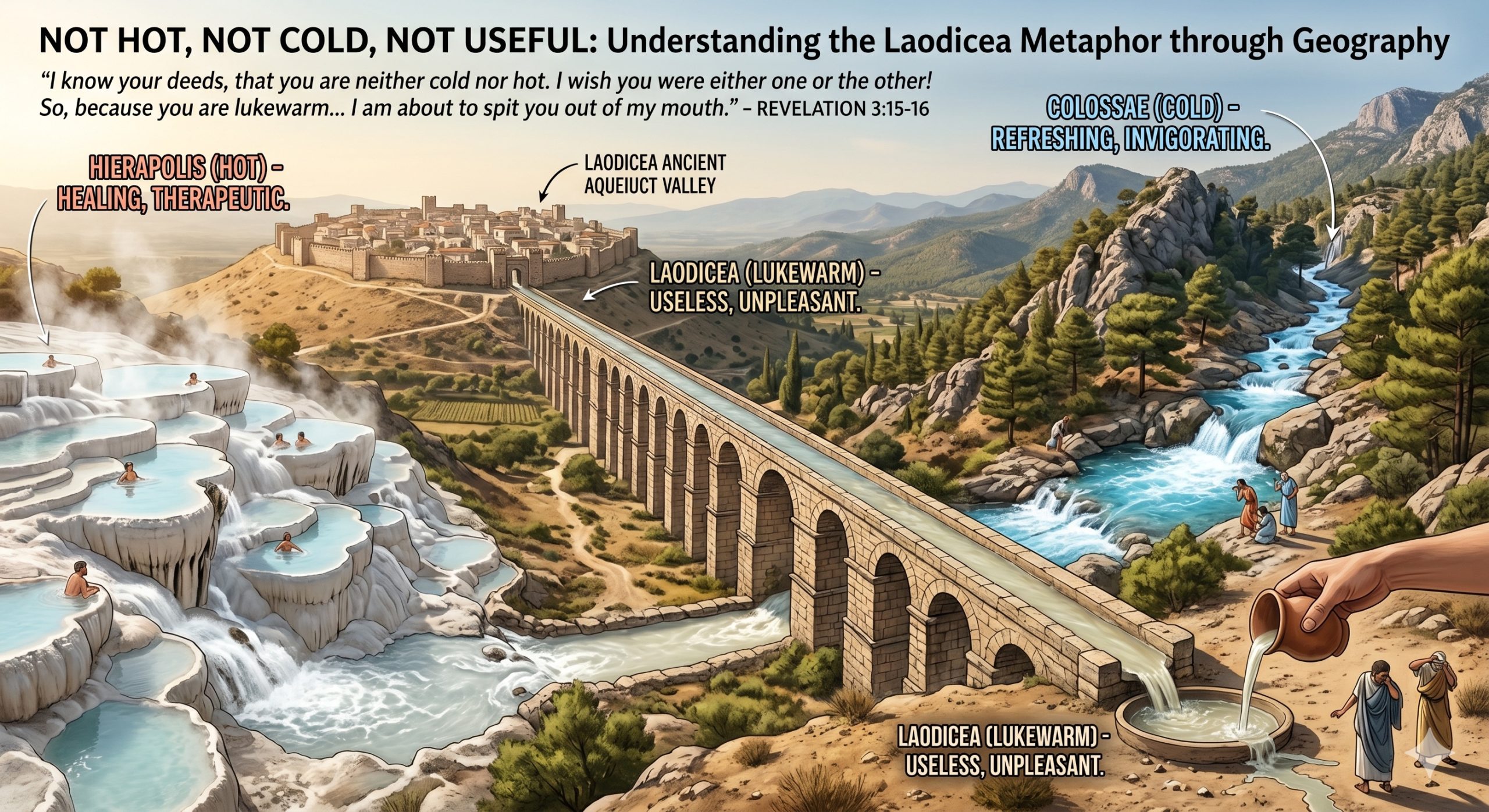
When Jesus dictated seven letters to seven churches in the Book of Revelation, he was not writing in the abstract. Each letter was addressed to a real community, in a real city, facing real pressures — and each letter drew on imagery the original readers would have immediately recognised. The letter to Laodicea is no different. It is one of the sharpest letters in the collection, and right at its centre is a metaphor about water. To miss the water, you miss the point entirely.
The key passage reads:
“I know your deeds, that you are neither cold nor hot. I wish you were either one or the other! So, because you are lukewarm — neither hot nor cold — I am about to spit you out of my mouth.”
— Revelation 3:15–16
Most people today read the word lukewarm and think: half-hearted, mediocre, not fully committed. And while that is not entirely wrong, it is dangerously incomplete. Without the geography, you lose the sharpest edge of the metaphor.
The Geography of Three Cities
Laodicea sat in the Lycus River valley in what is now western Turkey, a prosperous commercial city at the crossroads of major trade routes. It had two near neighbours, and understanding them is everything.
To the north, Hierapolis. This city was famous throughout the ancient world for its hot mineral springs. The waters bubbled up superheated from beneath the earth, rich with calcium carbonate, and cascaded down the hillside in spectacular white travertine terraces still visible today as Pamukkale — “Cotton Castle” in Turkish. People travelled from across the Roman world to bathe in these waters, which were believed to carry healing and therapeutic properties. The hot water was useful: it healed, it soothed, it served a clear and valued purpose.
To the south and east, Colossae. This city drew its water from cold mountain streams fed by the higher elevations. Cold, clean, fresh water — exactly what a person needs on a hot Mediterranean afternoon. That water was also useful: it refreshed, it invigorated, it quenched thirst.
Laodicea itself? It had no natural water source of its own. The city was wealthy enough — it famously boasted of needing nothing (Revelation 3:17) — but it was dependent on aqueducts to import its water from a spring roughly five miles to the south. And there lay the problem. By the time that water completed its journey through pipes and channels and arrived in the city, it had lost both heat and freshness. It arrived tepid: not hot enough to heal, not cold enough to refresh. Barely drinkable. The kind of water, as scholars Rudwick and Green noted in the landmark article that first mapped this context rigorously, that people found actively unpleasant.
Strabo, the first-century Greek geographer, actually recorded that Laodicea’s water had a tendency to calcify — much like the mineral-heavy water at Hierapolis — yet without the compensating benefit of being properly hot. The Laodiceans built the aqueduct, maintained it, and drank what came out of it, but they had no good options. Their water was simply the best available version of something nobody actually wanted.
The Metaphor Is About Usefulness
This is where the force of Jesus’ words lands. When he says he wishes the church were either hot or cold, he is not expressing a vague preference. He is invoking two specific, concrete images of water that actually does something — and contrasting them with water that does nothing.
Hot water heals. Cold water refreshes. Lukewarm water just sits there, unpleasant, making you want to spit it out.
The church at Laodicea had become exactly that. Prosperous, comfortable, and completely without edge. They were not aggressively anti-Christian, and they were not on fire for the gospel. They were somewhere in the middle — and Jesus’ point is that the middle is worse than either extreme. It is the water that makes you retch. It is the only state with no useful application.
The Amplified Bible captures this well in its translation of verse 15, rendering “hot” as healing and therapeutic and “cold” as invigorating and refreshing, and then describing the lukewarm as simply spiritually useless.
Jesus is not calling for performance. He is calling for function. Be the water that heals someone, or be the water that refreshes someone. Stop being the water that makes people gag.
The Faulty Reading: Saved vs. Unsaved
Many preachers and teachers have read this passage very differently — and the alternative reading is not only exegetically weak but theologically incoherent.
The misreading goes like this: hot represents a saved, fervent Christian; cold represents an unsaved, openly rejecting person; and lukewarm represents a kind of middle-ground, nominal Christian. The conclusion drawn is that Jesus would rather have someone be outright unbelieving (cold) than be a half-hearted believer (lukewarm). Sometimes this is extended to mean that a lukewarm person is not truly saved at all — and that the “spitting out” indicates loss of salvation or evidence of never having had it.
This interpretation falls apart on several levels.
First, it contradicts the immediate context. The letter is addressed to the church at Laodicea — not to outsiders, not to the surrounding culture, but to people who are already within the community of faith. The concern is not about whether they are saved, but about whether they are useful.
Second, it requires cold to mean something negative, when the entire geographic metaphor requires cold to mean something good. In the water imagery, cold is not spiritual death — it is the refreshing mountain stream of Colossae. It is exactly what you want on a hot day. Making cold mean “unsaved” forces a negative meaning onto something Jesus explicitly says he wishes for.
Third, it makes no sense theologically to suggest God would prefer someone to be unbelieving over believing. As one commentator notes, if God does not desire anyone to perish, then interpreting this text as Jesus preferring the unconverted over the converted fails basic logical consistency with the rest of Scripture.
Fourth, it misses the functional point entirely. The question is not about spiritual status. It is about whether a believer is having any effect on the world around them. Lukewarmness here means self-sufficiency — being so comfortable, so financially secure, so culturally settled that you have ceased to need God, ceased to serve others, and ceased to matter. “You say, ‘I am rich; I have acquired wealth and do not need a thing’” (Revelation 3:17). That is the diagnosis. The water metaphor is just how Jesus illustrates it in terms his first-century Laodicean readers could not misunderstand.
What the Warning Actually Looks Like
Laodicea was not a church of thieves, heretics, or persecutors. It was a church of comfortable, self-satisfied people who had blended into their wealthy civic surroundings and stopped being distinguishable from them. They had lost their usefulness. They were, in the language of the metaphor, water that had travelled a long way to arrive at room temperature — technically present, but offering nothing anyone actually needed.
The “spitting out” is not a declaration of damnation. It is an expression of disgust at futility. Jesus is not threatening to send them to hell; he is describing a condition that is beneath what he calls the church to be. Immediately after the warning comes an invitation: “Those whom I love I rebuke and discipline. So be earnest and repent” (Revelation 3:19). You do not invite those you have permanently rejected to repent.
The corrective is to become useful again — to let the hot spring heat come back, or to let the cold mountain stream clarity return. Either is better than the tepid, calcified non-offering of a church that has decided it does not need anything from God and has nothing worth offering to anyone else.
The Local Context Was the Point
The genius of Jesus’ metaphor is that it would have been obvious to every person in Laodicea who heard it. They lived with the frustration of their own water system every day. They knew exactly what lukewarm water tasted like, and they knew exactly why nobody wanted it. When Jesus said that is what you have become, there was no ambiguity, no need for footnotes, no theological commentary required.
For us, the footnotes are necessary — but once the geography is restored, the metaphor is just as sharp. Two kinds of water, both genuinely valuable, both doing something no other temperature can do. And then the water that does neither, that arrives at the worst possible point between the two, useful to no one, good for nothing except to make you wish you had something else.
Be hot. Be cold. Just stop being the water nobody asked for.
Bibliography
Academic Sources
- Koester, Craig R. “The Message to Laodicea and the Problem of Its Local Context: A Study of the Imagery in Rev 3.14–22.” New Testament Studies 49 (2003): 407–424. Luther Seminary / Cambridge University Press.
- Porter, Stanley E. “Why the Laodiceans Received Lukewarm Water (Revelation 3:15–18).” Tyndale Bulletin 38 (1987): 143–149.
- Rudwick, M. J. S., and E. M. B. Green. “The Laodicean Lukewarmness.” Expository Times 69 (1957–58): 176–178. (Cited within Porter and Koester above; original article not directly retrieved.)
- Wilson, Mark. “Neither Cold nor Hot but Lukewarm: Rethinking the Temperature Metaphor in Revelation 3:15–16.” Tyndale Bulletin 76 (June 2025): 1–29. https://doi.org/10.53751/001c.132253.
- Hemer, Colin J. “Laodicea.” In The Letters to the Seven Churches in Their Local Setting. JSNTSS 11. Sheffield: JSOT Press, 1986, pp. 186–191. (Cited extensively within Porter and Koester.)
- Strabo. Geographica 12.8.16–20 and 13.4.14. (Primary source cited in Koester and Porter for descriptions of Laodicean and Hierapolitan waters.)
- Özgüç, Nimet et al. “Did the Laodiceans Drink Lukewarm Water? A Hydrological Inquiry into the Temperature Metaphor in Revelation 3:15–16.” Lycus Valley Studies (2023). https://doi.org/10.51899/lycus.1381310.dergipark+1
Non-Academic Sources
- Leithart, Peter J. “Laodicean Water.” Theopolis Institute, 2 October 2016. https://theopolisinstitute.com/leithart_post/laodicean-water/
- “What Lukewarm in Laodicea Really Means.” Bible Gateway Blog, 6 June 2017 (updated 2020). https://www.biblegateway.com/blog/2017/06/what-lukewarm-in-laodicea-really-means/
- Scribner, Collin. “Lukewarm in Laodicea.” Part-Time Seminarian (Substack), 10 March 2026. https://parttimeseminarian.substack.com/p/lukewarm-in-laodicea
- “Why Is It Bad to Be Neither Cold nor Hot (Revelation 3:15)?” GotQuestions.org. https://www.gotquestions.org/neither-cold-or-hot.html
- “Biblical Places Spiritual Spaces: Colossae, Hierapolis, and Laodicea.” Seek the Lamb, 29 September 2021. https://www.seekthelamb.com/blogs/the-chief/biblical-places-spiritual-spaces-colossae-hierapolis-and-laodicea
- “A Lukewarm Interpretation of Hot and Cold: Revelation 3:15–16.” Andy Unedited, 28 January 2014. https://andyunedited.com/2014/01/28/a-lukewarm-interpretation-of-h/
- Bates, Mark. “The Letter to the Church in Laodicea.” Ligonier Ministries. https://learn.ligonier.org/articles/letter-church-laodicea
- “Laodicea on the Lycus.” Wikipedia. https://en.wikipedia.org/wiki/Laodicea_on_the_Lycus
- “Ancient Laodikeia (Turkey).” Ancient Water Technologies, 12 November 2018. https://ancientwatertechnologies.com/2018/11/12/ancient-laodikeia-turkey/


Leave a Reply