
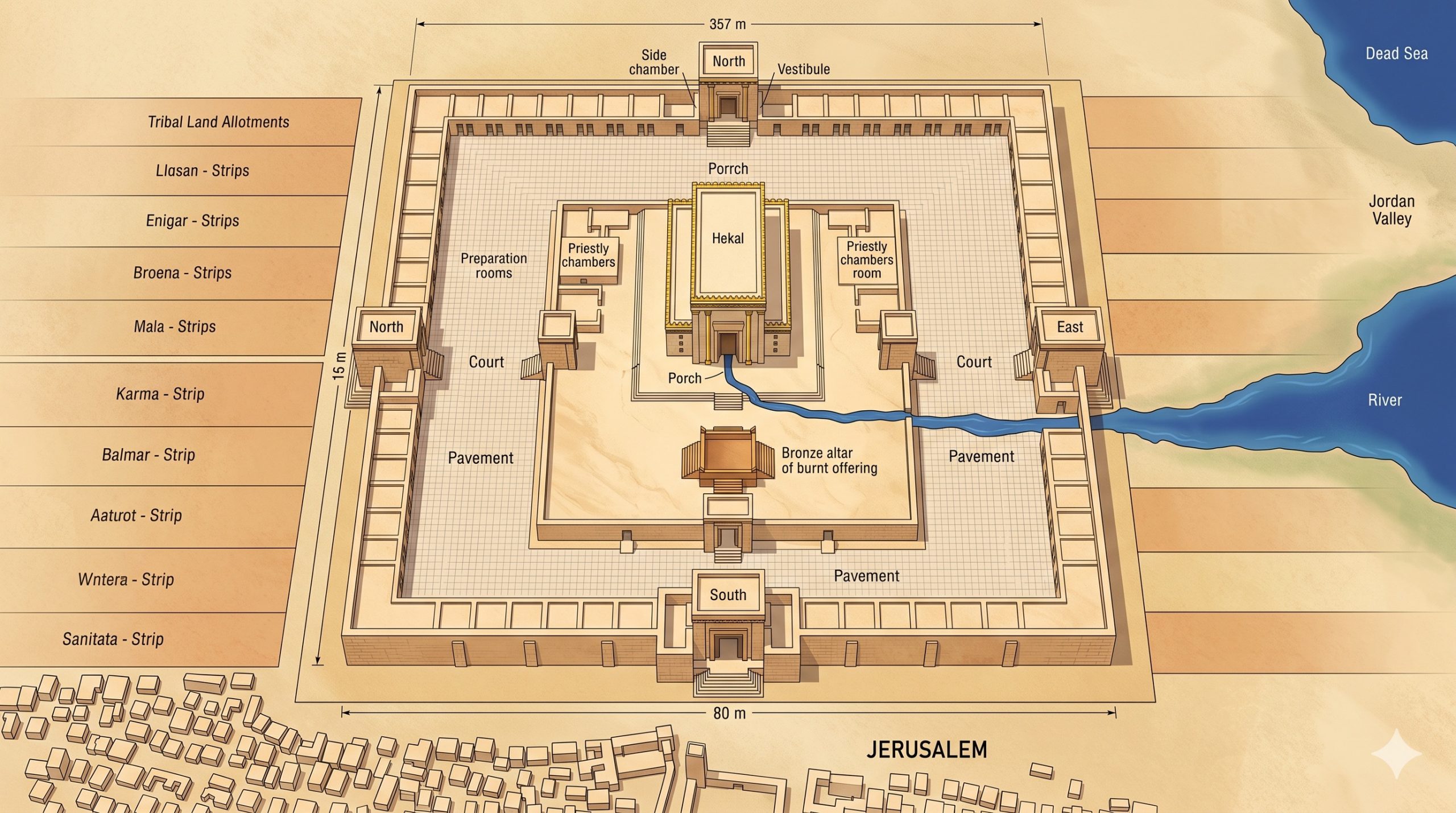
It is completely understandable to feel unsettled when you first encounter what Ezekiel describes in chapters 40–48. After spending time in the letter to the Hebrews — with its thunderous declaration that Christ offered himself “once for all” and that the veil is torn, the priesthood fulfilled, the sacrificial system completed — you turn to Ezekiel and find altars, priests, sin offerings, and burnt offerings in vivid, architectural detail. A temple. A new cultic order. Animals being slaughtered in the name of atonement.
For many sincere believers, the immediate reaction is: Does this not undo everything the cross accomplished? That is not a naive question. It is a theologically alert one. And it deserves a rigorous answer — not a dismissal.
The good news is that there is one. And it does not require softening either Ezekiel or Hebrews.
Why the Question Is Sharper Than It Looks
Most discussions of Ezekiel 40–48 either explain the temple away as symbolic (the amillennial or idealist reading) or offer a quick answer about memorials (a popular dispensational move). Neither fully satisfies. The symbolic reading runs into the problem that Ezekiel gives measurements, compass bearings, building materials, tribal allotments, and a river with measurable depth. If this is allegory, it is the most obsessively precise allegory in the entire Bible. As Robert Stein has noted in his work on biblical interpretation, allegory tends toward impression, not specification.
The memorial answer — that the sacrifices look back to the cross the way communion looks back to the Last Supper — is more appealing but exegetically thin. Ezekiel does not describe these sacrifices as memorials. He uses the Hebrew word kaphar, the same verb used throughout Leviticus for ritually efficacious offerings. He describes sin offerings with explicit atoning function (43:18–22; 45:15, 17, 20). These are not devotional gestures; they are prescribed mechanisms within a cultic-legal system.
So the question stands: if these sacrifices actually do something, how does that not contradict the book of Hebrews?
The Confusion at the Centre of the Objection
The most important thing to understand is that the objection assumes something Hebrews never actually argues.
Hebrews does not say that all ritual sacrifice is permanently abolished. It says that the Old Covenant’s sacrificial system was never sufficient for eternal atonement and was therefore superseded by Christ’s once-for-all self-offering (Heb 10:1–4). The author’s entire argument is soteriological: he is writing to Jewish Christians tempted to revert to the Mosaic covenant as a means of eternal salvation, and he is demonstrating that it was never capable of doing that job even when it was running.
This is not a small distinction. It changes the entire shape of the problem.
What the Levitical sacrificial system actually accomplished was fellowship maintenance within the covenant community — it “enabled the covenant community, despite the human proneness to sin, to maintain fellowship with the holy God” (Hartley, 1992, p. 18). This is a relational-covenantal function, not a soteriological one. In a Jewish worldview, forgiveness is characteristically “more often reminiscent of ensuring good fellowship between parties” than of conferring eternal standing before God (Dyer, 2001). Eternal forgiveness was always, throughout the entire Old Testament, grounded in the atoning work of Christ applied proleptically (Rom 3:25–26). The Mosaic system never competed with the cross for soteriological ground. It was a temporal-legal mechanism governing a theocracy under the divine Presence.
Furthermore, Hebrews itself confirms this when it distinguishes Christ’s ongoing intercessory work from his once-for-all propitiatory sacrifice. Drawing near to Christ in Hebrews 7:25 is not about securing eternal life — that was accomplished at the cross (John 5:24) — but about the ongoing relational dimension of the believer’s standing before God. As Hebrews makes clear through the Levitical parallel, the priestly system was always about facilitating that ongoing relationship, not about justification. The fulfilment of the Levitical system in Christ means that under the present covenant administration, drawing near to Christ through the Spirit replaces the outward cultic mechanism for relational access to God (1 John 1:9).
Once that is clear, the question about Ezekiel becomes much more manageable.
What Ezekiel’s Sacrifices Actually Do
The most focused academic treatment of this question comes from Jerry Hullinger’s doctoral work at Dallas Theological Seminary (1993), subsequently developed across several articles in Bibliotheca Sacra and the Journal of Dispensational Theology. Hullinger’s thesis is that Christ’s atonement and Ezekiel’s sacrifices operate in non-competing domains.
Hullinger argues — building on Richard Averbeck’s lexical work on kaphar in Leviticus — that the millennial sacrifices address a specific problem: the ritual defilement caused by sinful, mortal humans inhabiting a world in which the glorified divine Presence physically dwells. The Shekinah returns to the temple in Ezekiel 43:1–5. The River of Life flows from the sanctuary in Ezekiel 47. The entire sacrificial architecture of chapters 40–48 is structured around the problem of maintaining holiness in the immediate vicinity of that Presence.
This is not a novel idea invented to solve a modern theological problem. It is already present in Leviticus 16, where the Day of Atonement cleanses not just the people but the sanctuary itself — because even the building had been defiled by the presence of sinners. The logic runs: where God dwells among imperfect people, a mechanism for ritual-relational purity is necessary. In the Mosaic period, that mechanism was the Levitical system. In the Millennium, when Christ reigns physically from Jerusalem over mortal, unglorified nations, that mechanism is the Ezekielian system.
The cross is not reopened. The cross is presupposed — just as it was proleptically presupposed throughout every ox and lamb that fell on an Israelite altar for fifteen hundred years.
Why Christ’s Present Fulfilment Does Not Foreclose a Future Cultic Order
A sharp objection surfaces here: if the entire Levitical system is fulfilled in Christ and drawing near to him is now the sufficient mechanism for relational-covenantal access (Heb 7:25; 1 John 1:9), why would a physical cultic order need to exist in the Millennium at all?
The answer lies in the mode of Christ’s presence, which changes categorically between the present age and the Millennial age.
Under the current covenant administration, Christ is present through the indwelling Spirit. Relational access to God is mediated non-physically: prayer, confession, the gathered assembly, the ordinances. The believer draws near through the Spirit to the High Priest who sits at the Father’s right hand. No physical sanctuary is required because the believer’s body is the temple (1 Cor 6:19) and the community of believers constitutes the dwelling of God (Eph 2:22).
The Millennium introduces a categorically different situation. The Shekinah is physically localised in the Jerusalem temple (Ezek 43:1–5). Christ reigns as theocratic king from a specific geographical location — what Vlach (2017) describes as the fulfilment of God’s original design for a human viceroy ruling the world under divine authority, now fully realised in the Messiah’s priest-king reign. Mortal, unglorified human beings from both Israel and the nations live in proximity to this Presence and continue to sin. The conditions that made a regulated cultic approach to the divine Presence necessary in the Mosaic period are reconstituted, but under new covenant conditions and with a structurally different cultic order.
This is not a retreat from Christ’s fulfilment of the Levitical system. It is a mode-appropriate expression of the same underlying reality: sinful creatures require a regulated mechanism for approaching a holy God when that God takes up physical residence among them. In the Church age, the Spirit mediates this. In the Millennium, the Ezekielian cultic order mediates it — not as a competitor to the cross, but as the theocratic-civil expression of the new covenant’s relational logic applied to a physically present divine King.
The forgiveness operative in that system is what the Jewish worldview has always understood forgiveness primarily to be: restoration of fellowship between parties, not the conferral of eternal life (Dyer, 2001). Eternal life remains grounded in faith in Christ alone. The sacrificial machinery governs the relational-covenantal plane of life within the theocracy. As Dillow (2018, p. 71) observes, Hebrews bridges the semantic continuity between the testaments precisely by drawing on the Exodus-to-Canaan paradigm, where the land was always a reward, an inheritance conditioned on faithfulness — not a type of heaven, but a type of the Messianic Kingdom with its statuses and privileges.
The Ezekielian System Is Not the Mosaic System
One feature of this discussion that rarely receives enough attention is that Ezekiel’s cultic order is measurably, systematically different from the Mosaic one. This is not a minor detail. The Babylonian Talmud itself records that Rabbi Hanina ben Hezekiah was so troubled by the contradictions between Ezekiel and the Torah that he locked himself in an upper chamber with three hundred jugs of oil until he had worked through the difficulties (b. Menahoth 45a). Rabbinic scholarship did not miss the tension — it simply resolved it differently from Christian interpreters.
The divergences include:
- No high priest in Ezekiel’s system (Christ is the permanent High Priest)
- The Zadokite priests (not the full Levitical structure) officiate
- No Ark of the Covenant mentioned
- No Day of Atonement (Yom Kippur) in the full Mosaic form
- Different quantities and schedules for the offerings
- No Feast of Weeks, no Feast of Firstfruits in the Ezekielian calendar
- A prince figure (nasi) who is neither king nor priest but occupies a unique mediatorial role
These are not scribal errors or allegorical flourishes. They signal a structurally new expression of the covenant relationship — not a resurrection of the Old Covenant but a distinct, eschatological cultic order fitted to the conditions of the Millennium, including the physical presence of the glorified Christ as theocratic king.
Convergence Across the Prophets
The Ezekiel data does not stand alone. A consistent prophetic testimony across multiple independent voices anticipates sacrificial worship in the eschatological era:
- Isaiah 56:6–7 — foreigners bringing burnt offerings and sacrifices to the holy mountain
- Isaiah 66:20–23 — priests and Levites serving before God in the new age
- Jeremiah 33:18 — the Levitical priests “never lacking a man to offer burnt offerings, grain offerings, and sacrifices”
- Zechariah 14:16–21 — nations making annual pilgrimages to Jerusalem to keep the Feast of Tabernacles, with explicit consequences for those who do not
- Malachi 3:3–4 — a purified Levitical offering “pleasing to the Lord as in former years”
Zechariah 14 in particular is difficult to spiritualise, given that it is one of the most concretely geopolitical chapters in the prophetic corpus — naming specific nations, specific geography, and specific geophysical transformations. The sacrificial element in that chapter rides on the same interpretive train as the rest of it.
When five major canonical prophets independently describe a future sacrificial order, the burden of proof shifts decisively toward those who would allegorise it.
The New Covenant Is Not Anti-Ceremonial
There is a further assumption hidden in many objections: that the New Covenant, being spiritual and inward, is structurally opposed to outward ceremonial expression. This assumption owes more to Protestant spiritualism (particularly its Zwinglian and quasi-gnostic streams) than to the New Testament itself.
The New Covenant does not abolish ceremony. It internalises the soteriological basis of ceremony while transforming its mode according to the covenant administration in force. The Lord’s Supper is a ceremony. Baptism is a ceremony. The New Testament church gathered, read, sang, prayed, broke bread — a structured, embodied, repeated corporate practice. The New Covenant transforms what ceremonies mean and accomplish; it does not announce that all future religious life must be invisible and interior.
In the same way, the distinction between Old Covenant, Church-age, and Millennial worship is not between outward and inward, or between “carnal” and “spiritual.” It is a distinction between covenant administrations, each with its own mode of approach calibrated to the form of divine presence operative in that age. Outward ceremony and inward spiritual reality are not opposites — the one has always been the structured, communal expression of the other.
A Brief Note on the Symbolic Interpretation
The amillennial and idealised readings of Ezekiel 40–48 — associated with scholars such as Daniel Block in his influential NICOT commentary — argue that the vision is a theological ideal, communicating God’s restored presence with his people through imagery drawn from Israel’s cultic vocabulary. Block’s reading is exegetically careful and deserves respect. He acknowledges the precision of the measurements but argues that the overall architecture serves a theological-visionary function rather than a predictive-architectural one.
The problem with this reading is not that it is spiritually motivated but that it applies an interpretive principle inconsistently. The same chapters that describe the sacrifices also describe the tribal allotments (Ezek 47:13–48:35), the gates named for each tribe, the physical river, and the geographic boundaries of the land. If the measurements of the court are symbolic, so are the tribal boundaries and the river. But the tribal boundaries in Ezekiel correspond to the land promises in Genesis and Numbers. Spiritualising them requires spiritualising a continuous strand of covenantal promise running from Abraham through Joshua through the writing prophets — a move that carries significant theological cost.
The symbolic reading also struggles to explain why Ezekiel would deploy a sacrificial system that is structurally different from the Mosaic one as a symbol. If the point is to evoke continuity with Israel’s cultic heritage, why alter the specifics so markedly? The differences are more naturally explained as deliberate modifications for a new situation than as symbolic imprecision.
The Question Worth Sitting With
None of this removes all mystery. The relationship between Israel, the nations, the Millennium, and the form of eschatological worship remains a domain in which certainty should be held with humility. But the charge that Ezekiel’s temple sacrifices are theologically incoherent — that they constitute a betrayal of the gospel or a regression behind the cross — does not survive scrutiny.
The better frame is this: the cross accomplished, once for all and eternally, what the Mosaic sacrifices never could. The Levitical system was never a soteriology — it was a relational-covenantal mechanism for maintaining fellowship between a holy God and a sinful people living under his direct theocratic governance. When Christ reigns and the Shekinah dwells again among mortal humanity, the same God who instituted that mechanism at Sinai will institute a new one at Zion — not because the cross was insufficient, but because sinful humans near the holy God still require a structured way of approaching him that is calibrated to the mode of his presence.
That is not a concession to the Old Covenant. It is the consistent theological logic of a holy God taking up residence with imperfect creatures, tracing a line from Eden’s cherubim to the Mosaic tabernacle to Solomon’s temple to Ezekiel’s vision — and one day, to the city whose architect and builder is God himself.
Bibliography
Averbeck, R. E. (2003). Leviticus [Lexical and exegetical studies on kaphar]. Unpublished lexical analysis. Referenced in Whitcomb, J. C. (n.d.). Christ’s atonement and animal sacrifices in Israel. Pre-Trib Research Center.
Block, D. I. (1997). The book of Ezekiel: Chapters 1–24 (New International Commentary on the Old Testament). Eerdmans.
Block, D. I. (1998). The book of Ezekiel: Chapters 25–48 (New International Commentary on the Old Testament). Eerdmans.
Dillow, J. (2017). The doctrine of rewards. In F. Chay (Ed.), A defense of Free Grace theology with respect to saving faith, perseverance, and assurance. Grace Theology Press.
Dillow, J. (2018). Final destiny: The future reign of the servant kings (4th ed.). Grace Theology Press.
Dyer, S. D. (2001). The salvation of believing Israelites prior to the incarnation of Christ. Journal of the Grace Evangelical Society, 14(1), 43–55.
Hartley, J. E. (1992). Word Biblical Commentary: Vol. 4. Leviticus. Word.
Hullinger, J. M. (1995). The problem of animal sacrifices in Ezekiel 40–48. Bibliotheca Sacra, 152(607), 279–289.
Hullinger, J. M. (2006). A proposed solution to the problem of animal sacrifices in Ezekiel 40–48. Bibliotheca Sacra, 163(652), 405–422.
Hullinger, J. M. (2007). Two atonement realms: Reconciling sacrifice in Ezekiel and Hebrews. Journal of Dispensational Theology, 11(32), 33-63.
Stein, R. H. (1994). A basic guide to interpreting the Bible: Playing by the rules. Baker Books.
Vlach, M. J. (2016). Israel’s repentance and the kingdom of God. The Master’s Seminary Journal, 27(1), 161–186.
Vlach, M. J. (2017). He will reign forever: A biblical theology of the kingdom of God. Lampion Press.
Whitcomb, J. C. (n.d.). Christ’s atonement and animal sacrifices in Israel. Pre-Trib Research Center. Retrieved from https://www.pre-trib.org/pretribfiles/pdfs/Whitcomb-Ezekiel40thru48AndMillennialSacrifices.pdf
Leave a Reply