
Since I became a Christian, I have found one singular source of extreme joy: when God reveals Himself in the Scripture. When I am able to read a passage and connect it to others in the Bible, I experience the miracle of the only God working through time and space, reaching out to show me the power of His eternal Word.
“The grass withers, the flower fades, but the word of our God will stand forever.” (Isaiah 40:8)
In a world defined by endings—the passing of seasons, the fading of life, the constant flux of nature—I rejoice in seeing Someone who speaks and acts, who promises and fulfills, even Someone who died and rose again. When I see the Lord Jesus in the text, the power of that everlasting Word moves within me. It transforms my sorrow into joy, my needs into abundance, and my limitations into opportunities, giving me the boldness to proclaim it and the strength to obey it.
However, in modern evangelism, I often see a different pattern unfolding. Too often, we approach the Bible with a preconceived mind, compelling needs, and self-centered expectations woven into every verse. I fear that by doing so, we fail to plug ourselves into the true Source of Life, rendering the Word of God fruitless in our experience. But when we come to the text “naked,” devoid of personal projection, we discover the greatest treasure of all: the Author, and Jesus Christ His Son. HE is the prize we should all search in the biblical text and look to possess.
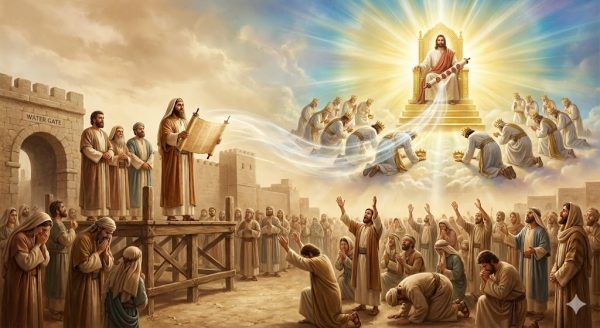
I felt it deeply at a Bible meeting last night. As we were reading Nehemiah 8, I had a distinct impression that the scene described was also elsewhere in Scripture. My mind turned to Revelation, and grabbing a Bible to compare the two, I was astonished. The similarities were too profound to be mere coincidence. Here is what I found.
The Tale of Two Assemblies
Both accounts center on a gathering of God’s people, a Priest, and a Book. The parallels are not accidental: they are designed by a God who declares the end from the beginning.
1. The Priest and the Reader
In Nehemiah 8, the people gather as one man. They call for Ezra the Scribe and Priest to bring the Book of the Law of Moses. Ezra stands above the people, the mediator of the Word for that generation.
In Revelation 5, we see a greater assembly in Heaven. A search is made for someone worthy to open the scroll—the title deed to the earth and the plan of redemption. John weeps because no one is found, until one steps forward: the Lion of the Tribe of Judah, the Lamb who was slain. Jesus, our Great High Priest, takes the scroll. Ezra was a shadow; Jesus is the substance.
2. The Center of Attention
In Nehemiah 8:4, Ezra stands on a high wooden platform built for the occasion. He is not alone; beside him, on his right and left, stand the leaders and Levites (Mattithiah, Shema, Anaiah, etc.).
In Revelation 5, the geometry of worship is perfected. The Throne of God is the center, surrounded by the four living creatures and the twenty-four elders. In both scenes, the reading of the Word is not a solitary but a communal act. The Word is at the center, supported by the testimony of the elders.
3. The Response: “Amen, Amen”
The physical reaction to the Word is identical in both realms.
- Nehemiah 8:6: “And Ezra blessed the Lord, the great God. Then all the people answered, ‘Amen, Amen!’ while lifting up their hands. And they bowed their heads and worshiped the Lord with their faces to the ground.”
- Revelation 5:14: “Then the four living creatures said, ‘Amen!’ And the twenty-four elders fell down and worshiped Him who lives forever and ever.”
This is the posture of a heart that has stopped trying to dictate terms to God. “Amen” means “Truly”, “It is certain”. It is the surrender of our will to His revelation, the seal of a faith that stands firm on the Truth as declared by the Divine. An act that reaches God’s heart and gives Him joy (Hebrews11:6)
The Mystery of Tears: Grace vs. Judgment
The most striking contrast between these two passages lies in the reaction to the opening of the Book.
In Nehemiah 8, as the Law is read, the people begin to weep. They are cut to the heart because the Law reveals their sin. They fear the judgment of God. But the Levites silence the weeping with a shocking command:
“This day is holy to the Lord your God; do not mourn nor weep… for the joy of the Lord is your strength” (Neh 8:9-10).
Why? Because that day was supposed to be a day of grace. God was restoring them from the long Babilonian captivity. They expected judgment, yet they received a festival.
This is also the times we live now. The people of the world has now the unique opportunity to receive justification, the forgiveness of all their sins, because we live in the day of grace, when Jesus’s sacrifice is “good news” and leads to eternal life through faith. Not a day of weeping, but a day of joy.
In Revelation, the scenario flips for the unrepentant world. When the Lamb opens the seals of the scroll, the people on earth do not find a festival. As the judgments unfold (Rev 6:16), the kings of the earth and the rich men hide in caves, crying to the mountains,
“Fall on us and hide us from the face of Him who sits on the throne and from the wrath of the Lamb!”
For those who are in Christ, the Book is a source of joy—a Nehemiah 8 experience where our tears of repentance are wiped away by the joy of the Lord. But for a world that rejects the Lamb, the opening of the Book signifies that the Day of the Lord has come. And that is a day of judgement.
The Promise of the Future: Sukkot Fulfilled
The reading in Nehemiah 8 led immediately to the rediscovery of a specific feast: Sukkot, or the Feast of Tabernacles. The people went out, gathered branches, and lived in booths/huts to remember their journey in the wilderness.
This was not just a history lesson; it was a prophecy. God has prepared everything from the beginning. The Feast of Tabernacles is one of the jewish feasts that has not yet been prophetically fulfilled in history. Passover was fulfilled at the Cross; Pentecost was fulfilled in Acts 2. But Sukkot points to the future.
The events of Revelation lead us to the Millennial Kingdom, the true fulfillment of Sukkot, where Christ will “tabernacle” (dwell) among us. Zechariah 14 tells us that in the Millennium, all nations will go up to Jerusalem to worship the King and keep the Feast of Tabernacles.
When we read Nehemiah, we aren’t just reading ancient history; we are reading a rehearsal for the preparation of the reign of Jesus. A typo of what the Lord has planned. We can marvell and stay in owe of the only God Who is able to tell the end from the beginning. And We can trust, He will bring it to pass.
Conclusion
In Nehemiah 8, the people stood for hours, attentive to the Book, not because it gave them a quick fix, but because it gave them the character of God expressed in His holiness. When we leave God to reveal Himself in the Word—honouring Him as the High Priest, the Lion, and the Lamb—we experience a transformation that none of our efforts can ever give.
Let us remember:
- He is the Prize: The comfort isn’t in the answer to your specific problem; the comfort is in knowing the One who holds the scroll and so the future of the world.
- He is the Joy: The people in Nehemiah found that “the joy of the Lord” was their strength, not the changing of their circumstances.
- He is the Boldness: Knowing that the Lamb holding the scroll has already secured the future makes our hearts bold. We don’t need to fear the news headlines; we know the end of the story.
Let us cease using the Bible as a mirror for our own feelings. Let us forget about ourselves when we approach it. Instead, let us look into it as if we look through a window into the Throne Room. There, we see the Lamb standing. There, we join in worship with the elders and the angels. There, we find the priceless treasure that fulfills our deepest needs: God Himself. He is the prize.

Leave a Reply to Mark DelSignore Cancel reply