

At Christmas, we often focus on the atmosphere, but there’s a juridical necessity behind the incarnation that we must understand to fully appreciate the proclamation of the good news. Everything revolves around the concept of the Go’el. But let’s start from the beginning.
The Fall
Imagine a noble and powerful family, possessing everything: land, authority, and wealth. One day, the founder commits a terrible crime, goes into deep debt, and sells off everything. Not only does he lose his possessions, but he also sells his children into slavery.
This is not a parable, but the story of humanity. The forefather is Adam. God had given him dominion over the planet, but by sinning against the true God, Adam “sold out” his offsprings (us), subjecting us to the yoke of slavery to sin and death. He abdicated his right of dominion, handing it over to Satan, whom Scripture calls “the prince of this world.” We are, spiritually speaking, bankrupt.
The Laws of Redemption (Leviticus 25)
To understand how to get out of this, we must look at the laws God gave to Israel. In Leviticus 25:25, 47-49, we read the laws of redemption:
“If one of your people becomes poor and sells part of his property, the one who has the right of redemption, his closest relative [the Go’el], will come and redeem what his brother has sold.”
These civil laws had an educational purpose: they taught an eternal lesson. To be a Go’el, an effective redeemer, three fundamental requirements had to be met simultaneously:
- Blood Requirement (Kinship): You had to be related to the person being redeemed. An outsider could not intervene.
- Power Requirement (Wealth): You had to have the means to repay the debt. Kinship alone is useless without resources.
- Willpower Requirement: You had to want to do it. No one could be forced to ransom a relative.
Let’s look at a practical example in the book of Ruth. There was a relative who was closer to Ruth than Boaz, and who had the right by blood. But when he discovered that the ransom included marrying Ruth and dividing his inheritance with her posterity, he backed out. He had the blood, perhaps the wealth, but not the will. Boaz, on the other hand, had all three: he was a relative, he was rich, and, moved by love, he wanted to redeem her.
The Great Cosmic Dilemma
When we apply this pattern to the redemption of humanity, we are faced with a seemingly insurmountable wall.
- Man’s Problem: To redeem Adam’s children, the redeemer must be a human being (blood requirement). But no man has the “spiritual riches” to repay the debt, because “all have sinned” (Ro 3:23). We are all slaves in debt; one slave cannot buy another.
- God’s problem: God has the infinite wealth to repay any debt. But God is not related to us. There is no blood relationship.
We are at a dead end. This is why Job, in the oldest text of the Bible, cries out in despair:
There is no mediator between us,
to lay his hand on both of us.— Job 9:33
In the Ancient Near East, “laying one’s hand on someone” meant identifying oneself 100% with that someone. Job sought a peacemaker who could be 100% human (to lay his hand on him) and 100% God (to lay his hand on God). In his time, such a person did not exist.
A Note on the Creation of Eve
Let me open a fascinating little parenthesis: when God created man, he created Adam from dust, but he didn’t create Eve from dust. He created her from Adam. Why? Perhaps there’s more than one reason, but one of them is certainly that he did it so that Eve would be of Adam’s blood and therefore redeemable. If she had been created separately, she would have been of another “race,” and Adam’s Go’el could not have redeemed her. This also explains why fallen angels cannot be redeemed: they are not part of the human race.
The Solution: The Incarnation
The legal need is answered when the Word becomes flesh (John 1:1, 14).
In Jesus Christ, the three requirements meet:
- Blood: Becoming a man, he becomes our next of kin.
- Power: Being God, he possesses the infinite wealth and purity to pay the price.
- Will: Jesus Himself says in John 10:17-18: “No one takes my life from me, but I lay it down of my own accord.” He had the power and the will to do so.
Christ is the mediator Job sought.
Sin and the Curse
But there were still two obstacles. The Messiah had to be:
- A human being without the sin nature, which is inherited biologically from the father (Genesis 5, post-fall, Adam’s children are in his image and likeness).
- The legitimate King of Israel, descendant of David.
Regarding the first point, the problem is obvious: if every descendant of Adam has a sin nature, how will the Messiah escape?
Regarding the second point, we have a problem in the genealogies.
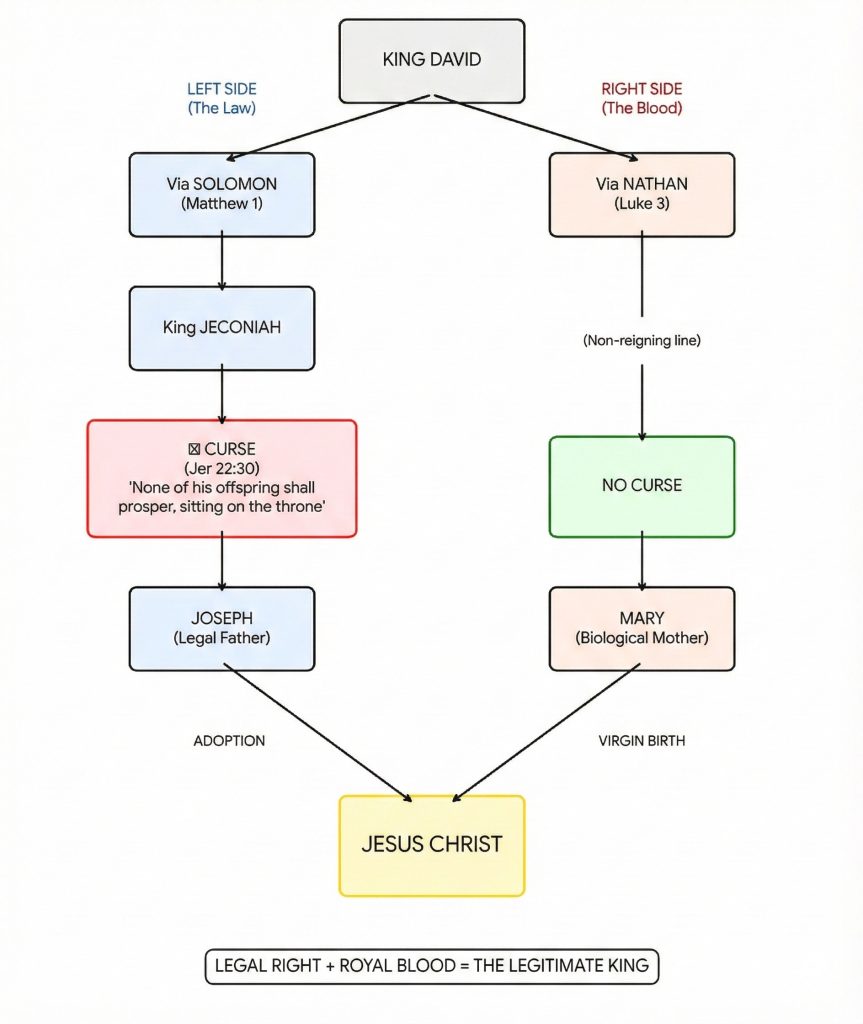
The royal line passed from David through Solomon. However, in Jeremiah 22, a descendant of Solomon, Jeconiah, is cursed by God: no one of his descendants will prosper on David’s throne. Yet it is from that line that the Messiah must come.
Joseph (Jesus’ legal father) was actually descended from Solomon’s line (Matthew 1). If Jesus had been Joseph’s biological son, he would never have been able to reign because of the curse.
On the other hand, Mary was descended from David through another son, Nathan (Luke 3). Nathan’s line had the blood of David, but not the legal right to the throne (which belonged to Solomon’s line).
The Virgin Birth is God’s juridical masterpiece:
- By being born of Mary (without a human father), Jesus bypasses the transmission of the sinful nature.
- Being the biological son of Mary, he has the “blood” of David (Nathan line).
- Being legally adopted by Joseph, he inherits the “rights” to the throne (Solomon’s line), but not being Joseph’s biological son, he does not inherit Jeconiah’s curse.
In a single move—the virgin birth—God solves the equation of sin and that of the throne simultaneously.
“Mary, did you know?”
All this brings us to Bethlehem. This is not a children’s story, nor a pagan celebration as many would have us believe, thus emptying it of meaning.
In Luke 2:11 the angel announces:
“Today in the city of David a Savior has been born for you, who is Christ the Lord.”
- Saviour: The Go’el, the redeemer.
- Christ: The promised messianic King.
- Lord: Kyrios (in Greek), Adonai (in Hebrew). A divine title.
Imagine Mary holding that child in her arms. As that wonderful song, “Mary, Did You Know?” says: Mary, did you know that that child has walked where angels have trod? That when you kiss his face, you are kissing the face of God? That that child sleeping in your arms is the Great “I Am”?
While the world sees a consumerist celebration or a “nice old man who brings presents,” or maybe even a sweet child born into humility, we have an obligation to see the truth.
The rich relative has come.
The debt has been paid.
The Infinite became finite through love.
The message of Christmas is that God didn’t send a delegate. He came himself to pay our debt. And to offer eternal life to all who believe that Jesus is the Christ, the Son of God.
Merry Christmas, brethren, the King is among us.


Leave a Reply to Mark DelSignore Cancel reply