
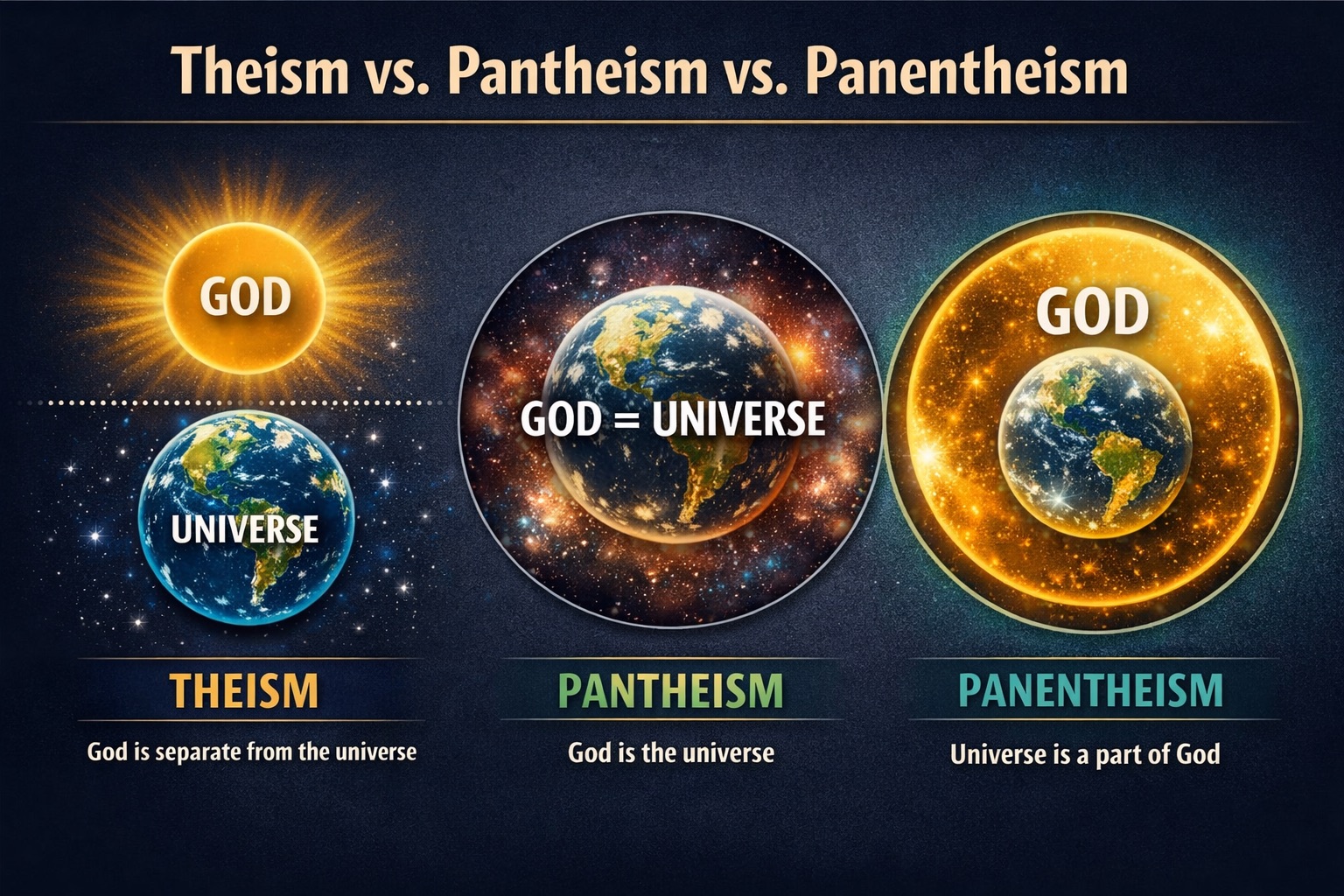
Pantheism and panentheism have gained renewed traction in contemporary Western culture, often without being named as such. These views are routinely smuggled into public consciousness through a variety of cultural avenues: New Age spirituality, certain strands of environmentalism (including ideological expressions within the vegan movement), and broader appropriations of Eastern religious thought. They are frequently popularised through Hollywood cinema, science-fiction narratives, and martial-arts or other Oriental films, where the divine is portrayed as an impersonal force permeating all things.
As a result, many people absorb panentheistic assumptions intuitively rather than argumentatively. God is spoken of as “the universe,” “energy,” or “the divine within all things,” while still being vaguely regarded as more than the world. This intuitive appeal, however, does not exempt panentheism from philosophical and theological scrutiny. When examined carefully, it proves to be internally unstable—particularly with respect to morality, evil, and divine perfection.
Pantheism and Panentheism Distinguished
Pantheism asserts a strict identity between God and the totality of reality: all that exists is God, and God is all that exists. Panentheism attempts to avoid the obvious difficulties of this position by introducing a distinction: the universe is in God but does not exhaust God. God is more than the world, yet the world is a constituent of God’s being.
At first glance, panentheism presents itself as a mediating position—retaining divine transcendence while affirming divine immanence more robustly than classical theism. In practice, however, this mediation proves unstable. The very move that distinguishes panentheism from pantheism introduces fatal tensions, particularly in the domains of moral ontology and divine perfection.
Moral Knowledge and Borrowed Capital
Human beings universally operate with moral categories such as good, evil, justice, and wrong. This is not an incidental feature of human culture but a structural aspect of human moral cognition. Even those who deny objective morality live as though some actions ought not to be done and others ought to be praised or protected.
Panentheism, however, lacks the metaphysical resources to account for this reality. It functions by borrowing moral capital from a worldview it cannot sustain—namely, the Christian doctrine of a morally perfect, self-existent, and ontologically distinct God.
In classical theism, moral norms are grounded in God’s immutable character. God is good essentially, not derivatively, and moral distinctions are neither arbitrary nor external to Him. Panentheism, by contrast, collapses this grounding by denying God’s independence from the world.
God’s Non-Distinction and the Problem of Evil
If the universe is a constituent part of God, then all that occurs within the universe—including moral evil—is, in some sense, internal to God’s own being. This is not merely a problem of divine permission or governance; it is a problem of divine constitution.
Evil, under panentheism, is not something God sovereignly allows while remaining morally untainted. It is something that belongs to God. The cruelty, injustice, and corruption of history become features of the divine life itself.
At this point, panentheism faces a dilemma. Either evil is genuinely evil, in which case God is not morally perfect; or evil is not truly evil, in which case moral distinctions are illusory. Either option is fatal.
The Collapse of Moral Meaning
Panentheists frequently respond by asserting that God remains the standard of goodness. Yet this response only deepens the contradiction.
If God includes evil as part of His being, and God is the standard of goodness, then evil cannot meaningfully be called evil. The category collapses. “Good” becomes indistinguishable from “whatever happens,” and moral judgment is reduced to subjective preference or pragmatic utility.
Yet panentheists do not live this way. They protest injustice, condemn violence, and praise compassion. Their lived moral framework contradicts their metaphysical commitments. This is not a minor inconsistency but a reductio ad absurdum: the worldview cannot be inhabited without denying its own conclusions.
The Denial of Divine Perfection and the Problem of Ultimacy
Some panentheists attempt to resolve the tension by conceding that God is not morally perfect—that God is in process, developing alongside the world. But this concession introduces a more serious metaphysical problem.
To say that God is imperfect is to imply a standard of perfection by which God is measured. That standard must be objective, normative, and independent of God’s current state.
But whatever functions as the ultimate standard of goodness is, by definition, God. If such a standard exists beyond or above the panentheistic deity, then that standard—not the panentheistic God—is truly ultimate.
This results in a contradiction. The real ultimate reality would be wholly distinct from the universe and from the mutable God–world composite, precisely the opposite of panentheism’s core claim.
The Necessity of Divine Transcendence
The Christian doctrine of God avoids these problems by affirming both immanence and transcendence without confusion or composition. God is present to the world as Creator and Sustainer, yet He is not constituted by the world. Evil is genuinely evil because God is genuinely good, and the two are not ontologically conflated.
Panentheism, in seeking to avoid a “distant” God, sacrifices the very conditions that make moral meaning possible. By denying God’s aseity, immutability, and moral independence, it undermines not only divine perfection but the intelligibility of good and evil themselves.
Conclusion
Panentheism fails not because it takes God’s nearness seriously, but because it does so at the cost of God’s otherness. In collapsing the Creator–creature distinction, it collapses moral ontology, divine perfection, and ultimacy. What remains is a metaphysical system that cannot account for the moral judgments it inevitably makes.
In the end, panentheism does not solve the problem of evil; it dissolves the very categories needed to recognise evil as evil. And in doing so, it reveals itself as internally incoherent, ethically parasitic, and theologically untenable.
Appendix: The Biblical-Theological Necessity of the Creator–Creature Distinction
The philosophical incoherence of panentheism mirrors its biblical inadequacy. Scripture consistently maintains a sharp Creator–creature distinction, not as an abstract metaphysical axiom, but as the necessary framework for worship, morality, and covenantal relationship.
From the opening verse of Genesis, God is presented as ontologically distinct from the created order: “In the beginning, God created the heavens and the earth.” Creation is not an emanation of God’s being, nor a modification of divine substance, but the result of divine volition. The text assumes, rather than argues for, a categorical distinction between God and what God makes.
This distinction is reinforced throughout the Old Testament. God is repeatedly described as the one who “dwells in heaven,” while the earth remains His possession, not His body. Even when God fills heaven and earth (Jeremiah 23:24), the language is covenantal and relational, not ontological. Presence does not imply composition.
Crucially, Scripture’s moral framework presupposes this distinction. God is not merely more powerful than evil; He is other than evil. His holiness is defined precisely by separation—qōdeš—not by inclusion. Evil is condemned because it stands in opposition to God’s character, not because it is a tragic feature of God’s inner life.
The prophetic literature makes this explicit. God judges injustice precisely because He is not implicated in it. The Psalms repeatedly appeal to God as judge on the basis of His righteousness, which would be unintelligible if righteousness and unrighteousness were both constituent elements of God’s being.
The New Testament intensifies rather than relaxes this distinction. God is described as “light, and in Him there is no darkness at all” (1 John 1:5). The statement is categorical, not comparative. Darkness is not a lower mode of divine existence; it is excluded entirely.
Even the incarnation, often appealed to by panentheistic thinkers, does not blur the Creator–creature distinction. The Word becomes flesh without ceasing to be God, and the flesh does not become divine substance. The hypostatic union preserves distinction without confusion—precisely the opposite of panentheism’s God–world synthesis.
Biblically, then, divine immanence is always grounded in transcendence. God is near because He is Lord, not because He is materially continuous with the world. Remove that distinction, and worship collapses into self-reference, morality into preference, and redemption into metaphysical self-realisation.
Panentheism, therefore, is not merely philosophically unstable; it is exegetically indefensible. It offers a God who cannot judge, cannot redeem, and cannot be worshipped without contradiction.


Leave a Reply to Vince Cancel reply