
There is a version of Easter that costs nothing. Chocolate, flowers, the vague warmth of spring — a cultural ritual that asks no questions and makes no demands. Christianity, however, is not in that business. The apostle Paul, writing to a church in Corinth roughly twenty years after the crucifixion, stated the stakes with uncomfortable clarity:
If Christ has not been raised, your faith is futile and you are still in your sins
— 1 Cor. 15:17
That is not the language of myth or metaphor. It is a falsifiable claim about a dateable event — and it is either the most important thing ever said, or it is nothing at all.
This article is for those who want to think carefully about that claim: what grounds it historically, what distinguishes it from the alternatives, and what it actually means to live inside it, especially now, in a world that has no shortage of reasons for anxiety.
The Historical Case in Three Facts
The standard apologetic move at Easter is to appeal to Scripture, but that concedes too much too quickly in a conversation with a sceptic. A more durable approach — developed principally by historian Gary Habermas — works from a floor of facts accepted by the broad consensus of critical scholars, including non-Christian ones. These facts are established not by faith but by standard historical methodology: multiple early attestation, enemy acknowledgement, and the criterion of embarrassment.
Three facts carry the argument.
Fact one: Jesus died by crucifixion. Roman execution was efficient and witnessed. The cause of death was not disputed by Jesus’ contemporaries — including his enemies, who would have had every incentive to contest it. No serious historian today holds the swoon theory. The starting point for any account of Easter is a corpse.
Fact two: The disciples reported post-mortem appearances and were transformed by them. Within a very short time of the crucifixion, a group of people who had scattered in fear were publicly proclaiming that Jesus had appeared to them alive. Paul’s list in 1 Corinthians 15:3–8 — which he describes as received tradition, not his own composition — names individuals and groups, including an appearance to more than five hundred people at once. The transformation is historically extraordinary: these were not people who gradually came to believe something comforting. They were people who, almost overnight, staked their lives on a specific claim and, in multiple cases, died rather than retract it.
The hallucination hypothesis is frequently proposed here, but it struggles on several fronts. Group hallucinations of this kind have no parallel in clinical literature. More importantly, a first-century Palestinian Jew who experienced a vision of a deceased rabbi would not have interpreted it as resurrection. Jewish expectation was of a corporate, end-of-age event — all the dead rising together at the last day. A private vision of Jesus would more naturally have been interpreted as his exaltation or spirit, not as his bodily rising in the middle of history. The resurrection interpretation requires an explanation of its own.
Fact three: Paul and James converted despite prior hostility or scepticism. Paul was not a wavering sympathiser — he was a persecutor of the early church who described his own record of violence against Christians with evident horror (Gal. 1:13). He dates and locates his reversal (Gal. 1:15–18; 1 Cor. 15:8–9), making it among the best-attested personal conversions in antiquity. James, the brother of Jesus, was sceptical during the ministry (John 7:5), yet became a pillar of the Jerusalem church and died for his confession that his brother was Lord. The best explanation for both conversions is the one they themselves gave: they encountered the risen Jesus.
The historian’s task is to find the explanation with the greatest explanatory scope — the one that accounts for all three facts with the least ad hoc qualification. Bodily resurrection is that explanation. Every alternative requires multiple independent improbabilities stacked on each other: the disciples lied, and no one broke ranks; they were deluded, but in an unprecedented and theologically specific way; the body was stolen, by persons who then died for the theft. Occam’s razor does not favour these reconstructions.
Not All Answers Are Equal
It is important to remind us all that Christianity’s claim is absolute: there is only one way. Jesus states he is the only way to the Father (John 14:6). And the resurrection seals that statement.
Yet the resurrection is not a claim made in a vacuum. Several major traditions engage it directly — not by ignoring it, but by responding to it. What follows is not a survey of world religions; it is a focused examination of three traditions that specifically address the resurrection claim and get it wrong in instructive ways.
Islam: Denial at the Foundation
Islam claims to be the rightful restoration of the original monotheistic religion, and it takes Jesus seriously — honouring him as a prophet, affirming his virgin birth, and anticipating his return. But the Qur’an states plainly that he was not crucified: “they did not kill him, nor did they crucify him, but it was made to appear so to them” (Q 4:157). Most classical Islamic scholars read this as a substitution — another person died in his place.
The consequence is structural. No crucifixion means no atoning death; no atoning death means nothing for a resurrection to vindicate. Islam offers a Jesus who is elevated but not redemptive — one who has not dealt with the problem of guilt before a holy God. Forgiveness in Islam rests on divine discretion, not a completed objective act. The question “how can I be certain my sins are dealt with?” has no anchored answer. Historically, the account also requires that the disciples — eyewitnesses who generated the entire early Christian movement within weeks — were collectively deceived, a scenario that demands a far more elaborate explanation than the resurrection itself, leaves their transformation unexplained, and implicates God in founding a religion built on a lie. That some Muslim scholars now acknowledge the historical difficulty (e.g., Reza Aslan) is telling.
Jehovah’s Witnesses: Resurrection by Redefinition
The Watchtower presents itself as Christian, which makes its error harder to detect. It does not deny the resurrection; it empties it. Official Watchtower doctrine holds that Jesus rose as a spirit creature, his physical body dissolved or disposed of by the Father, with post-resurrection appearances being temporary materialisations in borrowed form.
Jesus in Luke 24:39 addresses this directly: “a spirit does not have flesh and bones as you see that I have.” Thomas in John 20:27 is invited to touch the same wounds. The bodily continuity is not incidental — it is the text’s explicit point, and if the body was discarded, the appearances were deceptions. More fundamentally: if death was merely escaped rather than defeated, the “first fruits” logic of 1 Corinthians 15:20 collapses, and with it the believer’s own resurrection hope. The christological root is equally fatal — JW theology holds Jesus to be Michael the archangel, a creature. A finite creature cannot bear an infinite atonement, and the resurrection of a creature cannot ground justification in the way Romans 4:25 requires.
The Latter-Day Saints: Resurrection of the Wrong Jesus
LDS theology affirms a physical resurrection, which sounds like common ground. But the prior question is: whose resurrection? In LDS cosmology, the Father is an exalted man who progressed to godhood, Jesus is his firstborn spirit child, and Lucifer is Jesus’ spirit brother. The Jesus who rises is not the eternal second person of the Trinity but a created divine being — a different person of a different metaphysical order.
What his resurrection secures is also different: universal bodily immortality for all, regardless of faith. Forgiveness of personal sin and ultimate exaltation — the real goal, becoming a god — are not given; they are earned through temple ordinances, celestial marriage, and sustained obedience. The resurrection becomes a platform for meritorious progression, not the seal of a finished transaction. For the person asking “have I done enough?”, Mormonism opens a new and more demanding round of that question rather than closing it.
The shared diagnostic
Islam removes the event: no crucifixion, no atoning death, nothing to vindicate. The Watchtower retains the event but replaces the body, severing the continuity that makes resurrection meaningful and reducing Christ to a creature. Mormonism retains event and body but replaces the person — a different Jesus rises, securing an incomplete salvation. In each case, what is lost is identical: the complete justification of the ungodly (Rom. 4:5), grounded in the bodily rising of the eternal God-man, requiring nothing from the recipient but reception.
The Ground Beneath Our Feet
If the resurrection happened — and the historical case is stronger than most people realise — then it changes the terms on which everything else is evaluated. Including the present moment, which is not an easy one to inhabit.
The world in April 2026 is characterised, across multiple indices, by fragmentation and anxiety. Ongoing military conflict in Europe and the Middle East, the fracture of the post-war multilateral order, the weaponisation of information, and mounting economic uncertainty have produced what many analysts now describe as a structural shift: from a stable world order to a contested, multipolar one in which the rules are no longer agreed upon and the institutions no longer trusted. These are not merely news items. For many people, they represent the collapse of assumptions — about safety, about progress, about the durability of the structures they were told were permanent. The generation now in their twenties and thirties has come of age through cascading crises and may be the first in living memory to carry a settled expectation that the future will be harder than the past.
This is, in a strange way, an extraordinarily appropriate moment to reckon with the resurrection.
A fixed point. When institutions are unreliable, ideologies contradict each other, and the news cycle generates chronic low-level dread, the question beneath the anxiety is: is anything solid? The resurrection answers that question in the most concrete register available — not a principle, not a feeling, but an event. The kingdoms of this world are provisional; they always have been. But one kingdom has already demonstrated its permanence by defeating the one enemy no political order has ever overcome. Christian hope is not optimism about geopolitical outcomes. It is confidence in a Lord whose authority was established not by military or economic power but by walking out of a tomb. Whatever happens to the current world order, that verdict stands and is not subject to revision.
Freedom from the tyranny of alignment. One of the more insidious features of the present moment is the pressure to locate one’s worth and security in the right tribe — the right political cause, the right national identity, the right side of an increasingly binary public discourse. The polarisation is real, and the stakes feel high, because for many people tribal belonging is their source of meaning and assurance. The resurrection quietly dismantles this. The person who is fully justified before God — not by their political record, their national loyalty, or their moral consistency, but by the completed work of the risen Christ — is free. Their standing before the only judge whose verdict is final is settled, and no electoral result, no military outcome, no economic collapse can reopen it. This is not indifference to the world’s fractures; it is freedom within them. You can engage the crises of the present moment with clarity and even courage precisely because your security is not staked on any of their outcomes.
Grief without despair. There is a particular kind of grief in watching a world order unravel — not the sharp grief of a single loss, but the dull grief of diminishing horizons, of a future that keeps contracting. Paul’s word to the Thessalonians is precisely calibrated for this: “we do not want you to grieve as others do who have no hope” (1 Thess. 4:13). He does not say: do not grieve. He says: do not grieve as those who have no hope. Grief is legitimate. It is honest. What the resurrection removes is not the grief but the hopelessness — the sense that the wreckage is the final word. Jesus stood at a tomb and wept before he commanded the stone rolled away. He was not performing solidarity; he was genuinely moved. That same Jesus — bodily risen, presently reigning — is not indifferent to history’s fractures. He is simply not their prisoner. And neither, ultimately, are those who are in him.
Come and See
Easter is not primarily a liturgical season. It is an annual confrontation with the most consequential claim in history: that on a specific morning in first-century Jerusalem, a man who had been publicly executed walked out of his tomb, was seen by hundreds of people, and thereby demonstrated that death does not have the last word.
The question Easter puts is not “what does this mean to you?” That question is too small. The question is: did it happen?
If it did, then the other questions — about guilt, about death, about the apparent chaos of the present moment — have an answer that no political settlement, no military outcome, and no economic recovery can provide or revoke.
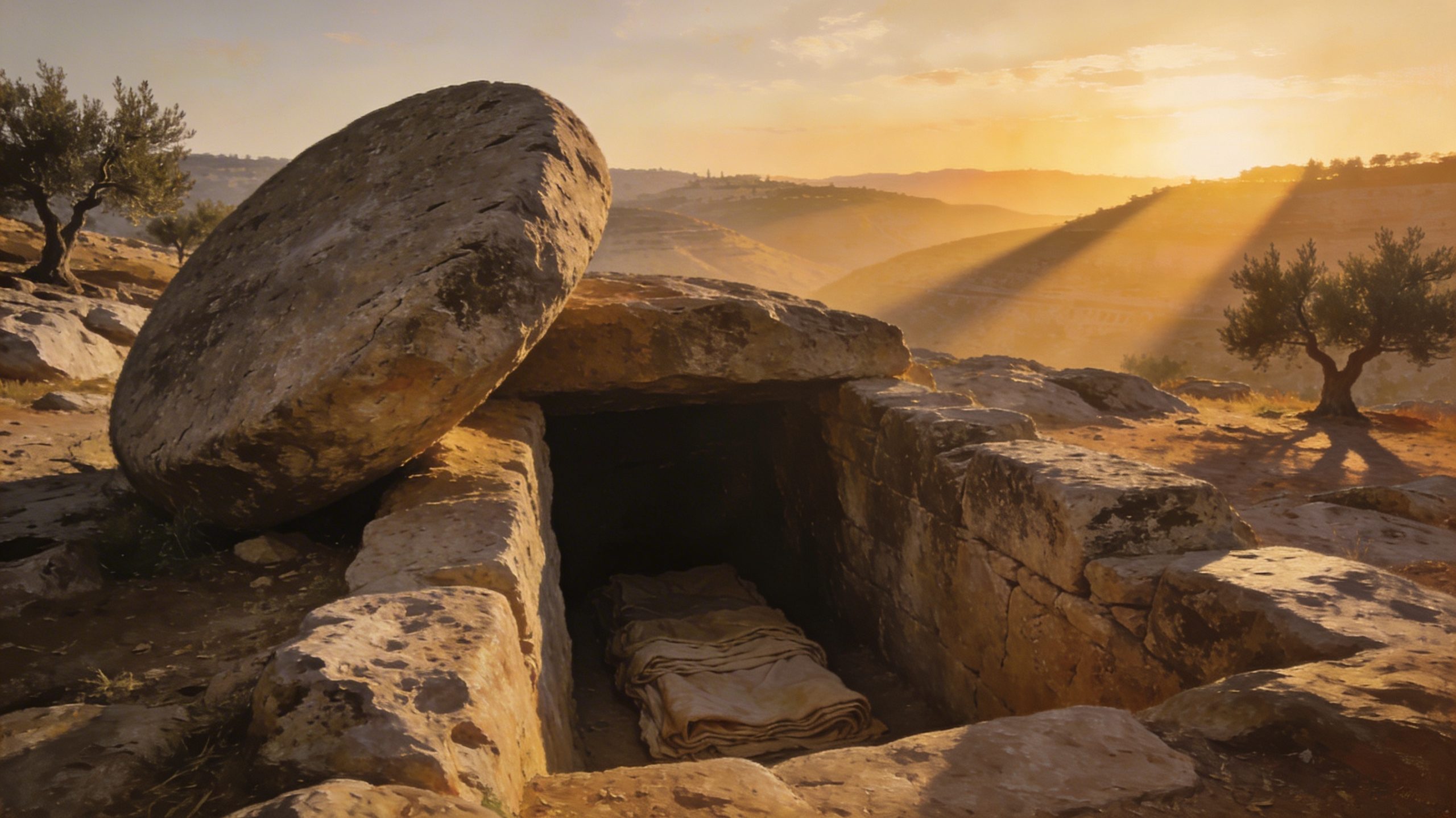
The stone is gone. The grave clothes are folded. The gardener has a name.
Come and see.
Bibliography
The Historical Case for the Resurrection
Craig, William Lane. Assessing the New Testament Evidence for the Historicity of the Resurrection of Jesus. Lewiston, NY: Edwin Mellen Press, 1989.
Habermas, Gary R. The Risen Jesus and Future Hope. Lanham, MD: Rowman & Littlefield, 2003.
Habermas, Gary R., and Michael R. Licona. The Case for the Resurrection of Jesus. Grand Rapids, MI: Kregel Publications, 2004.
Wright, N. T. The Resurrection of the Son of God. Christian Origins and the Question of God, vol. 3. Minneapolis, MN: Fortress Press, 2003.
Islam and the Resurrection
Accad, Martin. “The Gospels in the Muslim Discourse of the Ninth to the Fourteenth Centuries: An Exegetical Inventorial Table.” Islam and Christian–Muslim Relations 14, no. 1 (2003): 67–91.
The Qur’an. Translated by M. A. S. Abdel Haleem. Oxford: Oxford University Press, 2004. (Q 4:157 cited in the article.)
Jehovah’s Witnesses
Bowman, Robert M., Jr. “The Resurrection as Jesus’ Climactic Miracle.” Watchman Fellowship. Accessed April 2026. https://www.watchman.org/articles/jehovahs-witnesses/the-resurrection-as-jesus-climactic-miracle/
Martin, Walter. The Kingdom of the Cults. 6th ed. Revised and updated by Ravi Zacharias. Minneapolis, MN: Bethany House Publishers, 2019.
Rhodes, Ron. Reasoning from the Scriptures with the Jehovah’s Witnesses. Updated and expanded ed. Eugene, OR: Harvest House Publishers, 2009.
Watchtower Bible and Tract Society. “After Jesus’ Resurrection, Was His Body Flesh or Spirit?” JW.org. Accessed April 2026. https://www.jw.org/en/bible-teachings/questions/jesus-body/
The Latter-Day Saints
Beckwith, Francis J., Carl Mosser, and Paul Owen, eds. The New Mormon Challenge: Responding to the Latest Defences of a Fast-Growing Movement. Grand Rapids, MI: Zondervan, 2002.
Martin, Walter. The Kingdom of the Cults. (See above.)
Mouw, Richard J. Talking with Mormons: An Invitation to Evangelicals. Grand Rapids, MI: William B. Eerdmans, 2012.
Primary Sources (Scripture)
All biblical citations follow the English Standard Version (ESV). Wheaton, IL: Crossway, 2001.

Leave a Reply