
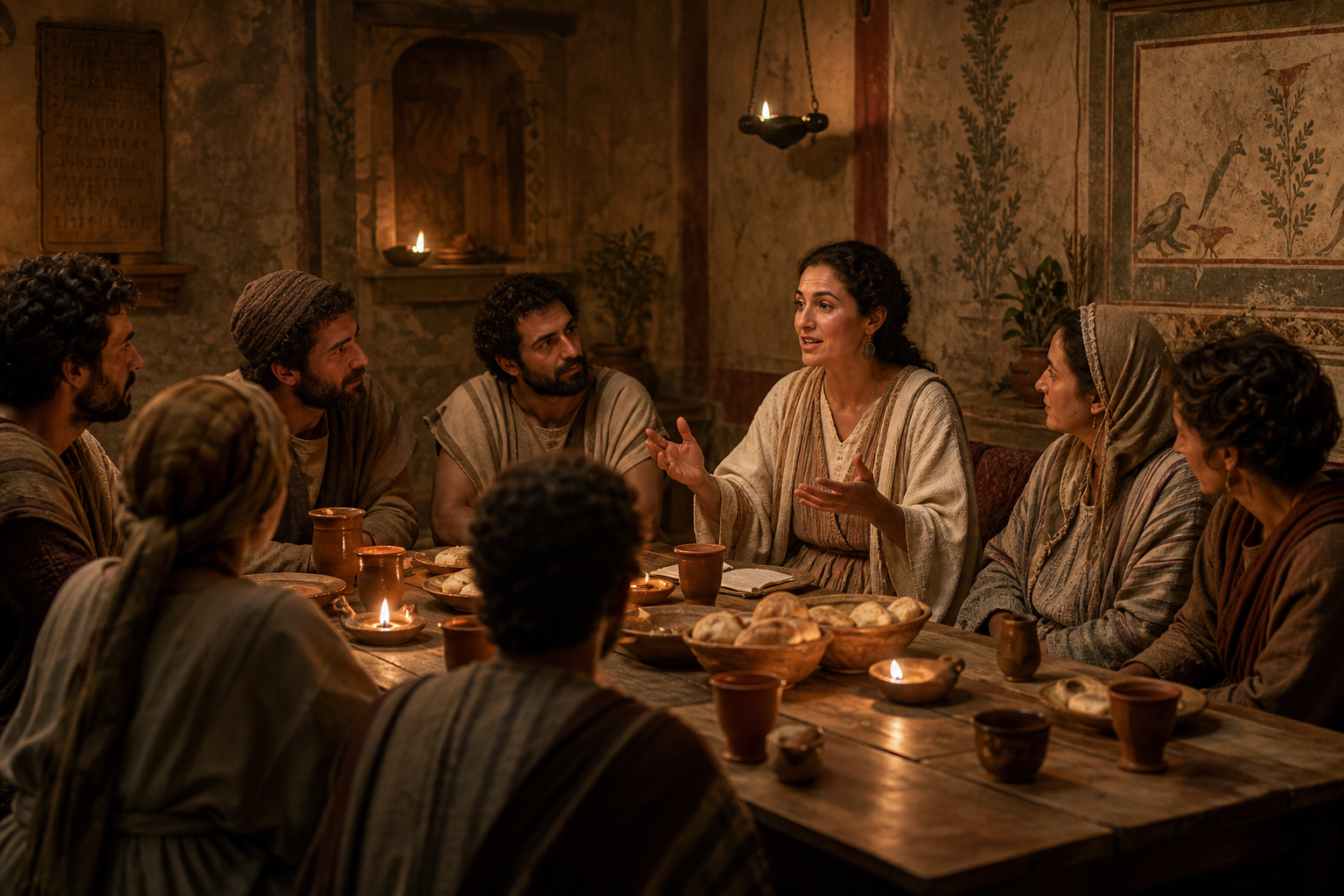
The evidence in Acts and the Epistles does not support a neat contrast between active male officeholders and merely supportive women. Women appear in the New Testament as disciples, prophets, patrons, teachers in at least some settings, hosts of churches, and named co-workers in the Pauline mission. The disputed question is therefore narrower than it is often presented: not whether women ministered, but whether certain governing and teaching functions were restricted, and whether those functions correspond directly to the modern pastorate.
Women in Acts
Acts presents women as participants in the church’s praying, prophetic, charitable, and mission-supporting life. The women in the upper-room gathering are included among the praying community awaiting the Spirit, Tabitha is explicitly called a disciple, Lydia becomes both convert and host, Priscilla participates in the instruction of Apollos, and Philip’s daughters are identified as prophets. This pattern is not incidental. Luke’s narrative places women inside the operative life of the church rather than at its edge.
Lydia is especially important because her role is not exhausted by private piety. Her household becomes a locus for Pauline mission in Philippi, which shows that patronage and hospitality were not secondary embellishments but part of the church’s actual social infrastructure. Priscilla likewise matters because Acts 18 portrays her, with Aquila, involved in the theological correction of Apollos, a learned and already influential teacher.
Women in the Pauline Letters
Romans 16 supplies the densest evidence. Phoebe is commended as a diakonos of the church in Cenchreae and as a prostatis, terms that many interpreters understand to indicate recognised ministry and socially substantial support. Prisca is named among Paul’s fellow-workers, and Junia is remembered in language that many scholars regard as most naturally identifying her as notable among the apostles, though the precise syntactical force remains disputed.
The force of 1 Corinthians 11 is equally significant. Paul regulates women praying and prophesying rather than forbidding those activities outright, which means female speech in the gathered church is presupposed. This creates an immediate tension for any reading of 1 Corinthians 14:34–35 that treats all female speech as prohibited without remainder. Whatever restriction is present in 1 Corinthians 14, it must be read alongside a chapter in which women are already assumed to be verbally active.
Pastor, Elder, and Overseer
A major source of confusion is the uncritical equation of the modern pastorate with the first-century office language. In the New Testament, “pastor”, “elder”, and “overseer” are closely related categories, and shepherding describes a function of local church leadership rather than the later professionalised role of a single sermon-centred senior pastor. That observation does not dissolve the question of restriction, but it does prevent a simplistic transfer from 1 Timothy to contemporary church structures.
This distinction matters exegetically. If the role under discussion in 1 Timothy is not identical to the modern pastorate, then appeals to that passage require a prior argument about continuity of office, not merely the assertion that “pastor” today is the same as “pastor” then. The debate is therefore partly lexical and partly historical-ecclesiological.
Phoebe and the Diaconate
Phoebe complicates any claim that formal church roles were uniformly male. Romans 16:1 calls her a diakonos of the church in Cenchreae, and many interpreters note that the same Greek term is used elsewhere for recognised ministers or deacons. Her additional description as a prostatis strengthens the impression that Paul is not merely thanking a helpful friend but commending a woman of recognised and effective ministry.
This is where 1 Timothy 3 becomes difficult for a clean male-only argument. The deacon qualifications are often read as requiring male officeholders, especially because of the “husband of one wife” language. Yet if Phoebe is genuinely described with the same ministerial term, then either Romans 16 uses diakonos in a broader, less technical sense, or the exclusionary reading of 1 Timothy 3 is too rigid.
Does diakonos Mean Something Different for Phoebe?
Some scholars and commentators do argue that diakonos in Romans 16:1 is broader than the technical office language in 1 Timothy 3. On that view, Phoebe is a minister, servant, or agent of the church in a real sense, but not necessarily a deacon in the later institutional sense. The argument is contextual rather than lexical: the word itself is flexible, and the pastoral epistles place it inside a qualifications list that appears more formally office-oriented.
Others resist that distinction because it can look selective. They argue that the same word should not be rendered “deacon” for male figures and “servant” for Phoebe without strong contextual reasons. That objection has force. Phoebe does not prove that Romans 16 and 1 Timothy 3 describe the office in exactly the same stage of development, but she does make it difficult to settle the matter by lexical fiat.
Implications for Male Restriction Arguments
Phoebe’s case does more than complicate the diaconate. It raises doubts about the wider method that reads the qualification formulas in 1 Timothy as if they automatically settled all questions of gender and office. The elder and deacon passages are structurally similar, and both include male-coded domestic language, but they are not identical in function because the elder list uniquely includes aptitude for teaching. That difference means Phoebe is not direct proof of women elders, but she does undermine any claim that the two lists are interpreted by a simple, uniform rule.
The more responsible conclusion is therefore narrower and stronger. The New Testament evidence does not yield a clean binary between male office and female assistance. It presents women as active agents in the church’s life and mission, while preserving unresolved questions about whether some governing-teaching functions were restricted in certain assemblies. The cut, in other words, is not as clean as many later formulations suggest.
Historical Narrowing
If the New Testament presents a varied and genuinely distributed pattern of women’s participation, then the next question is historical rather than merely exegetical: by what process did that breadth narrow into the later marginalisation of women? Corley’s Private Women, Public Meals is suggestive here, arguing that as early Christian communities developed around more public, socially regulated table-fellowship, and as they increasingly absorbed wider Greco-Roman patriarchal norms, women’s earlier visibility was progressively constrained. On that account, the later confinement of women was not the simple outworking of a flat biblical rule, but the result of a complex historical narrowing that deserves to be explained rather than assumed.
Leave a Reply