
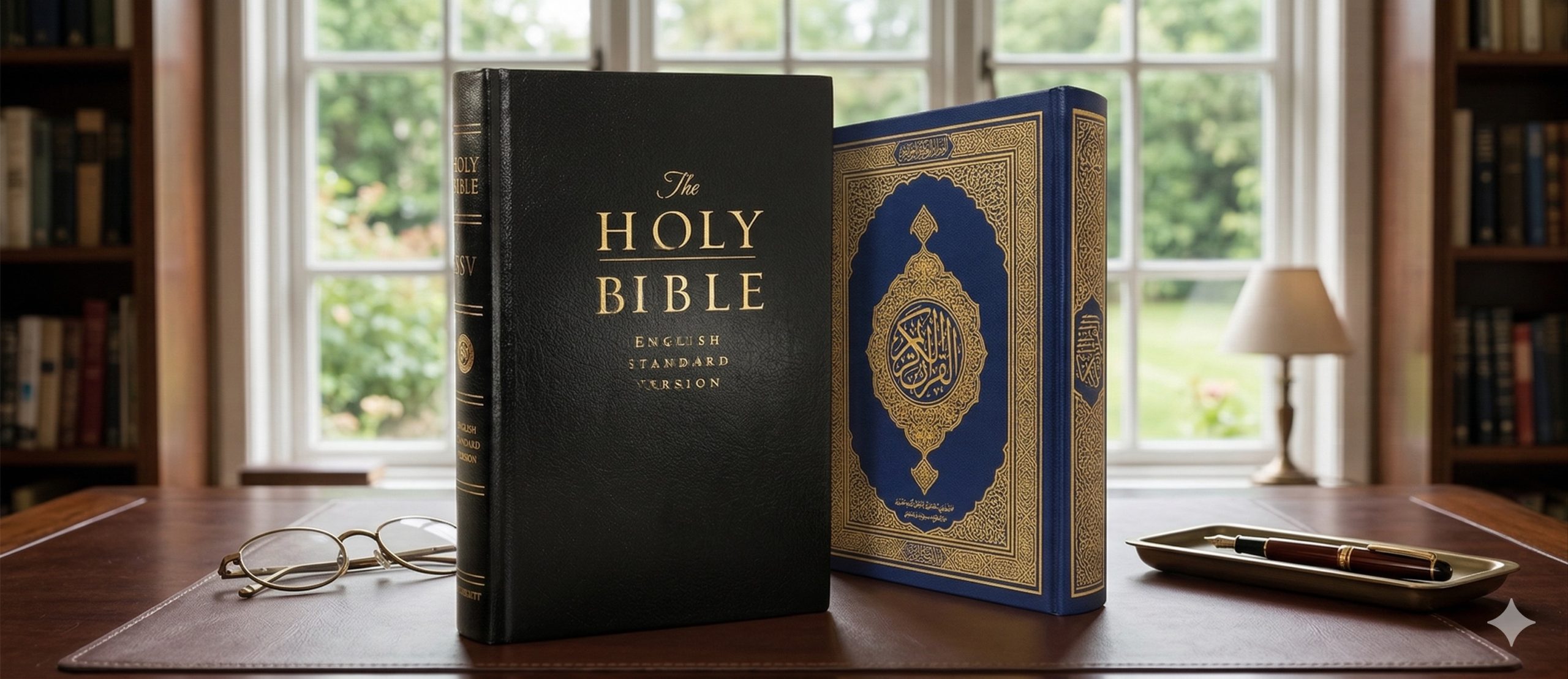
The Quran claims to be the final and definitive revelation of Allah. Yet this claim carries an internal contradiction that is worth examining carefully.
The Quran and the Bible
The Quran explicitly acknowledges the Jewish and Christian Scriptures as authentic divine revelation. A selection of relevant passages:
- “Say: ‘We believe in Allah and what has been revealed to us, and what was revealed to Abraham, Ishmael, Isaac, Jacob, and the tribes, and what was given to Moses and Jesus, and what was given to the prophets from their Lord; we make no distinction between any of them, and to Him we submit’” (Quran 3:84)
- “O you who believe, believe in Allah and His Messenger and the Book He revealed to His Messenger, and the Book He revealed before” (Quran 4:136)
- “Indeed, We revealed the Torah, in which there was guidance and light” (Quran 5:44)
- “This Quran could not have been produced by anyone other than Allah; it is a confirmation of what came before it”(Quran 10:37)
- “Do not argue with the People of the Book except in the best manner […] and say: ‘We believe in what has been revealed to us and what has been revealed to you’” (Quran 29:46)
The Quran further asserts that the words of Allah are immutable and inviolable:
- “No one can change the words of Allah” (Quran 6:34)
- “The word of your Lord has been fulfilled in truth and justice; no one can alter His words” (Quran 6:115)
These two elements — the acknowledged authenticity of the prior Scriptures and the immutability of Allah’s word — constitute the premises of the dilemma that follows.
If the Quran Is True, Then the Bible Is True — and the Quran Is False
If the Quran is true, then the Bible is the word of Allah, authentic and inviolable. But the Bible explicitly condemns anyone who comes announcing a message different from the one already revealed:
- “If a prophet arises among you […] and says to you, ‘Let us go after other gods’ […] you shall not listen to the words of that prophet” (Deuteronomy 13:1–3)
- “The prophet who presumes to speak a word in my name that I have not commanded him to speak […] that prophet shall die” (Deuteronomy 18:20)
- “I am the first and the last; besides me there is no God” (Isaiah 44:6)
More directly still, the Bible presents Jesus as the sole mediator between God and mankind, who died for our sins and was raised for our justification (Romans 4:25), as the only name given among men by which we must be saved (Acts 4:12), and as the way, the truth, and the life — without alternative (John 14:6). The New Testament describes Jesus as a high priest who “is able to save to the uttermost those who draw near to God through him” (Hebrews 7:25), in direct contrast to the Quran’s assertion that no one will be able to intercede for another on the day of judgement (Quran 2:48).
In short: if the Quran is true, the Bible is authentic divine revelation. But the Bible contradicts the Quran on fundamental points. Therefore, if the Quran is true, the Quran is false.
Corollary
The most common escape route at this point is to argue that the Bible has been corrupted (tahrif) over the centuries, and that the Quranic affirmations therefore refer to an original text now lost. But this move is blocked on two fronts.
The first is theological: if the words of Allah cannot be changed (6:34; 6:115), then the Bible — as a revelation of Allah — cannot have been corrupted. Whoever maintains the corruption of the Bible must therefore concede that the Quran contradicts itself on a theologically central point.
The second is historical and textual: the Bible as we know it today was already available in its entirety before the emergence of Islam. The four great manuscript codices — Codex Sinaiticus, Codex Vaticanus, Codex Alexandrinus, and Codex Ephraemi Rescriptus — date to the fourth and fifth centuries, two to three hundred years before Muhammad. To these are added thousands of partial manuscripts and patristic citations that allow the New Testament text to be reconstructed with remarkable precision. There is no historical or textual evidence of a systematic revision of the Scriptures — no identifiable moment at which it could have occurred, and no surviving alternative tradition to attest to it.
The more sophisticated version of this objection speaks not of textual corruption (tahrif al-lafz) but of interpretive corruption (tahrif al-ma’na): the words would have remained intact, but their meaning would have been distorted. This move fails for the same reason, however: the Quranic guarantee concerns the words of Allah (6:34; 6:115), not a putative original intent separable from the text. If the text is intact, the revelation is intact.
Many Contradictions
One might object at this point that the Bible itself contains internal contradictions, and is therefore no more reliable than the Quran. This is an argument worth taking seriously — but it does not lead where one might expect.
First: the Quran itself offers a criterion for distinguishing true revelation from false. According to Quran 4:82, the absence of contradictions is the seal of divine authenticity: “Do they not reflect upon the Quran? If it had been from other than Allah, they would have found within it much contradiction.” Applying this criterion to the Quran itself, documented contradictions are found — including those already illustrated in relation to the prior Scriptures. The Quran, then, does not pass its own test.
Second: the alleged contradictions in the Bible, when examined carefully, concern in most cases differences of narrative perspective, literary genre, or theological emphasis — not factual or doctrinal errors. The debate on this point is long-standing and cannot be resolved in a footnote, but it is worth noting that the Bible has withstood centuries of textual and historical criticism without its central doctrinal coherence being undermined.
Conclusion
The dilemma that emerges is simple: either the Quran is true, and then the Bible is the word of Allah — but the Quran is false; or the Bible is corrupted, and then the Quran is false in any case. For Islam, there is no way out.
The Bible, for its part, presents a remarkable theological coherence: 66 books, more than 40 authors, three continents, three languages, approximately fifteen hundred years of composition — and yet a single narrative thread running from creation to redemption. The criterion that God himself chose to authenticate revelation is prophecy: whoever can announce the future with absolute precision, without ever erring (Deuteronomy 18:21–22), demonstrates that he speaks in God’s name (Isaiah 44:6–7). The Bible satisfies this criterion throughout.
Muhammad, by contrast, is not announced in any of these texts. The prophet anticipated in Deuteronomy 18 is specifically Israelite — and Muhammad is not. But even setting aside the genealogical requirement, he fails the content-based test of Deuteronomy 13: whoever announces a message that contradicts prior revelation does not come from God, regardless of the signs he brings.
Jesus paid the debt that each of us has incurred before God. Whether to believe this is a personal choice — but it is not a choice one can make rationally whilst ignoring the evidence that the Bible itself provides.
If this article has raised questions or you would like to discuss further, I am available in the comments.
Leave a Reply